
At CDN we put a lot of emphasis on honesty, including asking people to admit, present and take seriously evidence that appears not to fit their prevailing worldview. So we have to as well, for instance on the recent heatwave in Europe. Yes it happened and yes it was hot (though one of us was there at the peak and rather enjoyed the break from Ontario’s never ending cold). And everyone was on it from Reuters “Sustainable Switch” and the Reuters article it linked to to France24 (“scientists warned the extreme weather reflects the growing impact of climate change across a rapidly warming continent”) to Climate Home News. As the New York Times predictably put it, “As Climate Change Extends Europe’s Heat Season, Schools Bake”. We won’t get distracted that climate change is a description of alterations in the weather not a cause of it and that schools aren’t “baking”, a process that only happens between about 140-165C or 280-330F. But we will insist that climate change is by definition a change in weather patterns somewhere over 30 years. So if Europe really is slowly but steadily thrusting schoolchildren into red brick ovens over a period of many years it is a phenomenon requiring attention, explanation and concern. But “iff”, as the mathematicians say, meaning if and only if. Thus far the evidence does not say so.
One reason it doesn’t is that global warming, as it used to be known, and global heating as it sometimes still is, ought surely to be global. Just as climate change the big bad troll not the fact that weather fluctuates everywhere, often in pseudo-trends, really ought to be a global phenomenon. Instead, predictably, wherever they’re discussing is warming faster than the average. Or worse:
“Europe is the world’s fastest-warming continent, with temperatures rising by about 1 degree Fahrenheit per decade since the 1990s. This is in part because of changing weather patterns, as well as its proximity to the Arctic, where melting snow and ice lead to more dark surfaces that absorb heat.”
On which point they might want to mention that there has been no trend in melting Arctic ice since around 2007. Or not, lest it damage their theory.
Likewise ScienceAlert blared “World’s Fastest-Warming Continent Swelters Under Record ‘Heat Dome’”. But as we’ve pointed out before, there’s nothing in orthodox global warming theory, let alone mere meteorology or climate science, that says warming will make heat domes more common. Also, the piece says:
“The planet is around 1.4C warmer than in preindustrial times, defined as 1850-1900. By comparison, Europe is around 2.4 hotter than the preindustrial era, according to the EU’s Copernicus Climate Change Service.”
But if you ask similar outfits not based in Europe, they’ll say they’re the main target. It’s a strange competition. But we digress. That piece actually did too, at one point agreeing with us then veering off:
“High-pressure systems, which bring settled weather and higher temperatures, have become more common in Europe, Copernicus Director Carlo Buontempo said. “If you look over the last 20, 30 years, there has been a prevalence, especially in summer, of those sort of anticyclonic conditions that are making heatwaves more likely,” Copernicus Director Carlo Buontempo told AFP. Whether the increased frequency of that specific type of high-pressure system is due to climate change or is just a “statistical fluctuation” is still a scientific debate, Buontempo said.”
(The increased frequency of putting the complete phrase “Copernicus Director Carlo Buontempo” in consecutive sentences also seems to be increasing. Oh, in case you were wondering, in a weird coincidence his name actually does mean “good weather”.) But now you see it, now you don’t:
“Such high-pressure systems are also known as ‘blocking highs’ as they can remain stationary and stop other weather systems from moving into a region. Explaining how they work, Mary Bourke, geography professor at Trinity College Dublin, told AFP: ‘The sky is exposed to us, there are no clouds. It’s a stable mass of air that is bringing warm air down to the surface and taking away moist air, so the air is not only warm, but it’s also dry.’ ‘Europe is connected to the Arctic, which is warming much faster than the rest of the planet,’ [Ben Clarke, researcher in extreme weather and climate change at Imperial College London] said.”
Uh what does the Arctic have to do with it, unless you’re blaming heatwaves on ice? Or is it just a distraction after the experts who say failed to say what you wanted to hear?
Meanwhile, naturally, Climate Home News went straight to Friedericke Otto, though without mentioning her role in World Weather Attribution:
“Friederike Otto, Professor of climate science at Imperial College London, said 35C in the British springtime is ‘absolutely astonishing’ but ‘temperature records will continue to tumble until we fundamentally halt global emissions and reach net zero’.”
Which doesn’t even make any sense if you assume that current levels of CO2 are having an ongoing warming effect. But we mention it because in the New York Times “Climate Forward” scientific uncertainty is relegated to the rubbish heap of advocacy by David Gelles thusly:
“The culprit was a ‘heat dome’ caused by warm air that moved up from northern Africa and is now stuck under a high-pressure system that has settled across western Europe. And it comes as global temperatures continue their rapid rise in recent years, fueled by the unrelenting burning of fossil fuels. Scientists have said the anomalous warmth is almost certainly linked to human-caused global warming. ‘This record-breaking heat has the fingerprints of climate change all over it,’ Friederike Otto, professor of climate science at Imperial College London, said in a statement.”
As she always does. But she is not the scientists who say. She’s one media-friendly outlier who such people quote unrelentingly. (Another being ClimaMeter.) Gelles also sees the parent publication’s baking and raises it to about 500F:
“The broiling temperatures represented an early start to the heat season in Europe. Last year, almost all the continent was unusually hot, according to the annual European State of the Climate report. Europe is warming faster than any other continent, and researchers estimate that in recent years it has seen tens of thousands of heat-related deaths annually.”
But note that “Last year” because a two-year blip is not a trend and, as the original Times piece cited in the introduction also accidentally emphasized, this summer is unusual:
“Between 1979 and 2000, daily average temperatures in the northern hemisphere would rise above 64 degrees Fahrenheit on May 25 and remain above that threshold – a decent proxy for the warm season – until Sept. 27. But last year, temperatures stayed above 64 degrees Fahrenheit from May 13 until Oct. 7, according to data from the University of Maine’s Climate Change Institute. In 2024, they remained above that mark from May 14 until Oct. 11, a difference of nearly four extra weeks.”
OK. But what about between 2000 and 2024? Because if there’s been a steady trend it means something different than if there’s been a sudden spike.
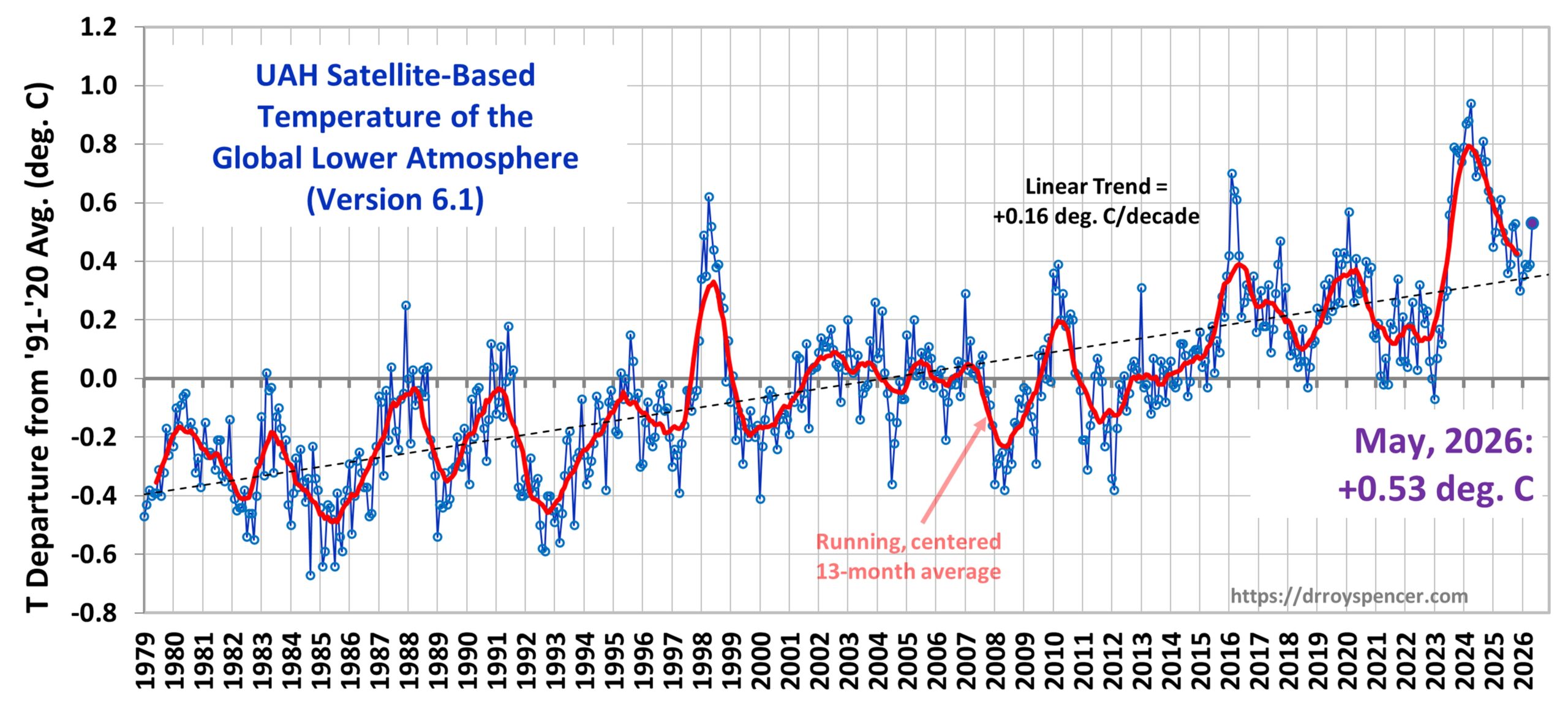
One thing we keep a close eye on in this regard is the UAH satellite temperature series. And it does show that May of 2026 was hotter than, say, April or January. But it also shows a mysterious spike in 2023 and 2024 that is actually far too steep to be confirmation of the “Enhanced CO2 Effect Hypothesis”, and then a plunge that doesn’t fit with it at all.
To his credit, sort of, Bill McGuire in the Guardian proclaims that it is a trend. Under the headline “Heatwaves are becoming the norm. This is what Britain will look like in the year 2052”, and we do repeat that journalists do not with rare exceptions write their own headlines, he goes Mad Max on us:
“If you think the temperature uncomfortable today, let me take you to the last day of July 2052, the rays of the climbing sun reveal a city still sweltering in the residual heat of the day before. From the air, London resembles a colossal refugee camp. Streets, gardens and parks are teeming with tents and cobbled-together shelters, within which the city’s residents have spent another uncomfortable night away from the heat traps that their houses and flats have become. After six days when the temperature peaked at about 40C, another scorcher is on the way.”
As with RCP8.5, he somehow has emissions continuing to climb even with “the extreme temperatures making cables sag and break and causing transformers to overheat” which you’d think would shut down the power plants. But never mind. The point is that if such things really do happen in 26 years and we haven’t been baked, broiled, roasted and charred into embarrassed silence we will concede that it’s a trend. But not, even so, that it means what they think it does… including McGuire with his capitalist plot to get rich by burning their own house down:
“Bearing in mind that we continue to pump out CO2 equivalent to the weight of 800,000 Titanics every year, and fossil fuel corporations are actively planning to expand operations, it is practically impossible for emissions reductions to happen fast enough to reduce the rate at which our world is heating.”
The reason these trends are not what they seem is that something else the Times and all these other outfits tastefully omit is that Europe has seen a dramatic, unexplained decrease in cloud cover in the last quarter-century. And with less cloud cover, more sunlight hits the surface and you get warming for reasons that are utterly unrelated to our Titanics of CO2.
When we say last quarter century, the decrease has actually been longer. But not the “unexplained” part. The shutting down of dirty East Bloc industries following the collapse of the Soviet Union seems to account for the process from 1983 through around 2002, as smog that screened out sunlight dissipated and good riddance.
Bloomberg, which sticks to mere baking, also mentions the clouds without drawing any useful lessons:
“The weather system has pushed away cloud cover across a wide swath of the UK, leading to unusually sunny skies that have further intensified the heat while also boosting solar power generation. At its peak around midday on Sunday, solar met almost half of the UK’s electricity demand – the highest-ever, according to data from NESO.”
So there’s that.
There’s also this, and it’s far more important. Vanishing cloud cover causes heating but is not caused by GHGs. This mysterious decrease in the early 21st century, and if CO2 absorbs clouds nobody told us, does appear to have been essentially global. And to have operated on a massive scale. Just since 2015 its impact on solar radiation reaching the surface amounts to almost three-quarters of the alleged impact of GHGs since the 18th century. And we do also know, at least from the evidence in paintings, that Europe saw a massive increase in cloud cover in the early part of the Little Ice Age, and the skies cleared significantly in the 19th century.
We don’t know why. Not even to the point of knowing whether it was a consequence of temperature changes, a cause of it, a complex mix of both or even, though it seems improbable, a coincidence.
If so, it doesn’t mean European schools are not getting hotter. Or that it doesn’t matter that they’re getting hotter. But it does mean that whatever’s going on, it’s not us and our carbon sins. And it does matter.
P.S. Shortly before this heat dome became a hot item, another columnist in the New York Times “The Morning” wrote chirpily: “If Memorial Day is the unofficial beginning of summer and Labor Day the unofficial end, then I am pleased to inform you that we are embarking on the longest unofficial summer: From Monday, May 25 to Monday, Sept. 7, this year delivers the earliest and latest possible dates for both holidays. For those of us still reeling from the cold shower of last year’s Sept. 1 Labor Day, this is very welcome news.” No, no. Warmth bad. Broiling. Baking. Unrelenting. We are all going to dieeeee!


Here in Wales we had, yes, about a week with higher than usual temps and not a cloud in the sky. Then the clouds moved back in and hey presto! For the last two weeks it's been a miserable and rainy 11-12 C. I think it must be caused by the weather.
Nikolov & Zeller's 2024 paper "Roles of Earth’s Albedo Variations and Top-of-the-Atmosphere Energy Imbalance in Recent Warming: New Insights from Satellite and Surface Observations" details the high correlation (R2 of 0.86) between cloud albedo and temperature using NASA CERES data. As Nikolov points out such a high correlation leaves no room for a radiative greenhouse effect.
"that there has been no trend in melting Arctic ice since around 2007"
The overall long-term trend since satellite tracking began in 1979 shows a loss of roughly 12% to 13% of summer sea ice per decade. Climate models show that decadal pauses are entirely normal within a long-term warming trajectory
While the two-dimensional surface area has paused its decline, the three-dimensional volume has not. The Arctic has lost the vast majority of its thick, multi-year ice. The current ice pack is dominated by thin, fragile, first-year ice that is highly vulnerable to future melting.
Changes in albedo are not a major cause of warming at night because albedo is strictly a measure of how a surface reflects incoming solar radiation (sunlight). Because the sun does not shine at night, changes in a surface's reflectivity cannot directly cause nighttime warming.
europe and other continents, except for antarctica, warm faster than the global average because they are 100% land, and the global average is 71% water
antarctica is unique, with a negative greenhouse effect over most of the continent due to a permanent temperature inversion