
A few years back, also known as 2022 (can it be that long? we ask the greybeard in the mirror) we ran a series called Everybody Knows, in which we looked at facts about climate change that everybody knows to be true, or at least everybody who’s anybody to the busybodies, and because everybody knows, nobody needs to check, but we checked, and they’re not true. One of the entries was on how global wildfires are getting worse… except they’re not. So we were not surprised that when the DoE Red Team Report also looked at the data they found the same thing. Global wildfire activity is trending down not up. Everybody who knows they’re getting worse is plain wrong. Not to mention unreliable, cavalier with evidence and often shockingly condescending about it into the bargain.
The satellite record only goes from 2001 to 2018, which is not really long enough to establish a trend of any sort. But in case somebody told you it is and it does, you should know that it looks this way:

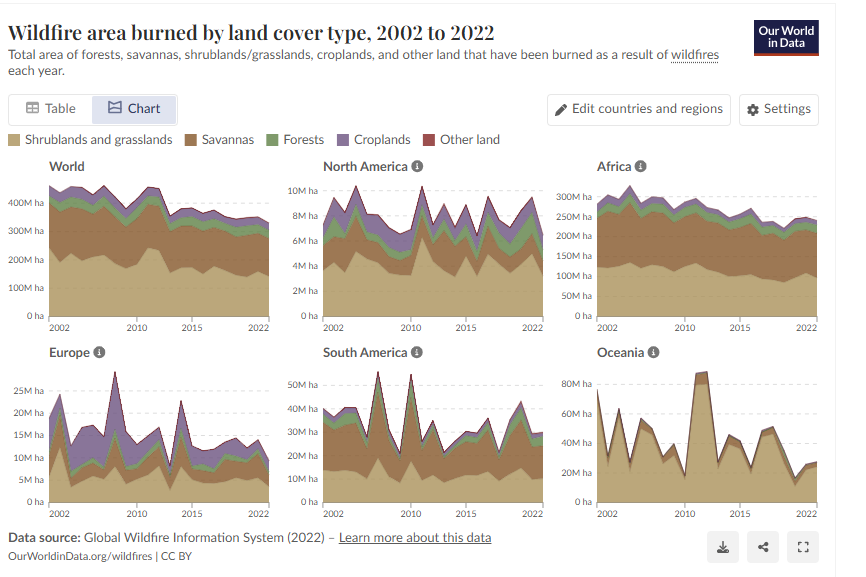
The different lines are estimates constructed using different satellite records or different processing algorithms. (So here we add that if anyone tells you the data behind the supposed settled science is itself also rock-solid, you should not believe anything else they say either because they are ignorant, maniacal or both.) Then there is the record at OurWorldinData which the DoE mentions without showing it, and which looks this way:
There is also the US record, a remarkable series that goes back further, to 1926, and shows that prior to the era of modern fire suppression wildfires were far more common and covered more land than in recent decades:
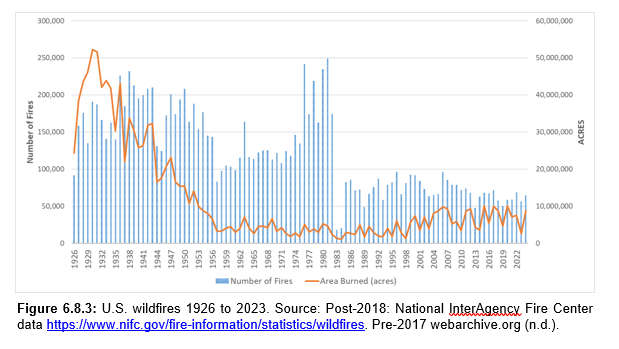
Of course the fact that the big change is in fire management means it’s not clear evidence of the underlying ecological trend, if any. But there is also paleoclimate evidence that not only shows the extent of fire before the 20th century, but also allows scientists to estimate how much wildfire there should be in the US under current weather conditions if nature were allowed to run its course:
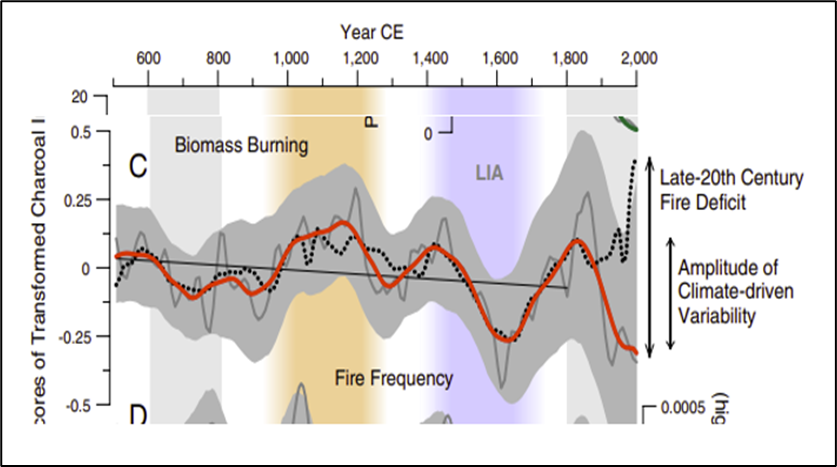
With the usual caveat about the assumptions built into reconstruction, and projection, the black dotted line shows the predicted fire rate absent human intervention and the red the estimated actual rate. The gap at the end is the “fire deficit”: the amount of fire nature would have brought us under these assumptions, minus what actually happened. And it comes with a warning of a different sort.
While fire suppression has helped spare life and property from the ravages of burning, for logical reasons, and while the trend is if anything downward over nearly 1,500 years before the divergence, that deficit means there are large buildups of fuel in US forests so when they do ignite, they can truly explode out of control because wildfires have always been common and natural and still are, and human action has thus far caused a lot fewer not a lot more.
Next up: Sea levels





Also, the Canadian Wildfire Information Service chart shows no sweeping trends in the number of fires or area burned since 1970
https://cwfis.cfs.nrcan.gc.ca/ha/nfdb
Canada’s boreal forests are generally considered to be about 8000 years old. Yet individual mature trees are about 100 to 125 years old. What seems to most likely explain the preponderance of newer trees….insects, old age, totem pole harvesting, woodpeckers or fires ?
It's well known that virtually all stands in the Boreal forest are of fire origin. You might find a stand of older tress (say around 300 Year old) of climax species (Balsam fir) but even they eventually get the lightning, blowdown, insects or disease culmination.
the US acres burned should be ignored before 1940 because prescribed fires were being included in the acres burned and that's not a wildfire
much more important is that up to 90% of wildfires are man-made and that really has no connection with the global average temperature ... i can't find any correlation between global average precipitation and global average acres burned by wildfires ... lightning is responsible for over 80% to 93% of the total area burned in Canada. & lightning is a major contributor to the total acreage burned in the sparsely populated Siberian taiga. these natural lightning fires could be related to precipitation in those areas but i don't find any data for precipitation in those areas
OBITUARY: The DOE Climate Working Group Report, 2025–2026: The CWG Report’s death was announced in footnote 8 of the EPA’s Endangerment Finding rollback:
https://substackcdn.com/image/fetch/$s_!k5qG!,f_auto,q_auto:good,fl_progressive:steep/https%3A%2F%2Fsubstack-post-media.s3.amazonaws.com%2Fpublic%2Fimages%2Fd82c0474-d3d6-4ff8-826f-e414be8c7a34_528x260.png