
If a major tornado were to sweep through Ottawa, or indeed any town, the usual ghouls would be out in force declaring it proof of climate change and the evils of humanity. But the data tell another story. According to Roger Pielke Jr. the updated US record on hurricane damages and hurricane frequency from 1950 to 2025 show they are on downward trends. So if we’re going to blame every trend on greenhouse gases, do they also get to take credit for this one?
As Pielke Jr. often points out, more often than he should have to given how obvious the point is, if you are going to measure damages over time in real dollars, from natural disasters or anything else, they need to be normalized for the growth of the economy. A twister today can do a lot more damage than in the 1950s because there is more stuff in its path. And obviously, or so you’d think, it’s also necessary to adjust for inflation since the apparent dollar value of the stuff has been inflated by rising prices eating away the purchasing power of dollars.
A great many worsening-weather scare stories omit both, from incompetence or tunnel vision. But when, for instance, US tornado damages is appropriately normalized the result looks like this:
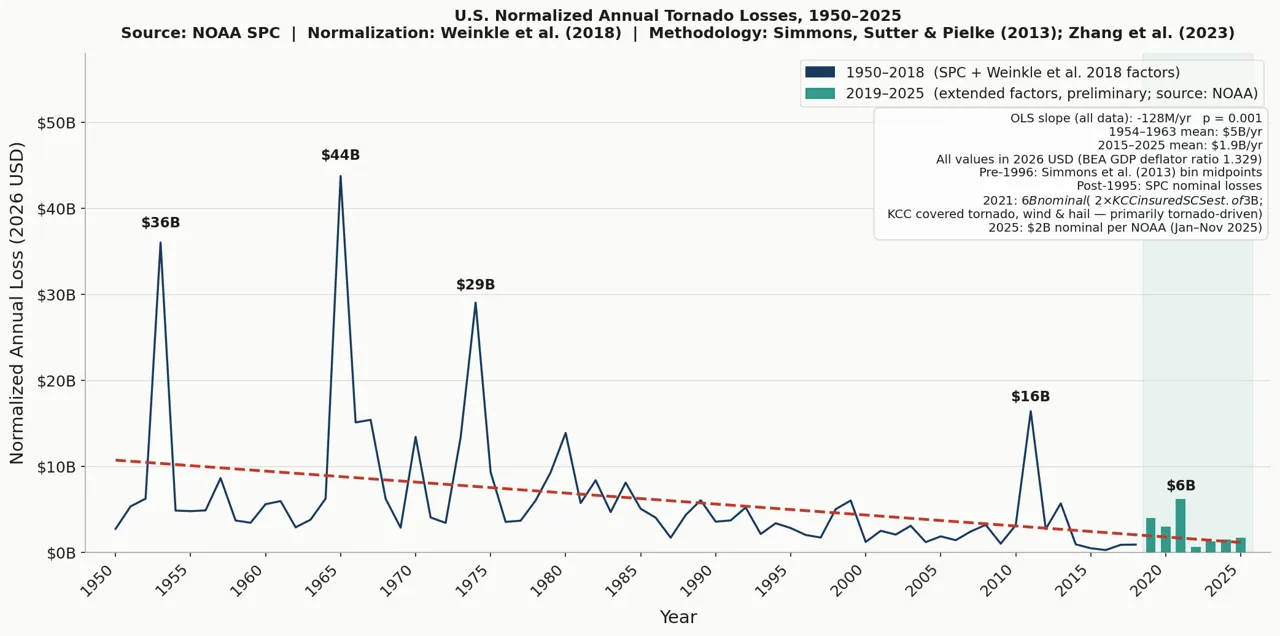
As RPJ notes:
“The dominant loss years are 1954 ($36 billion),1965 ($44 billion), and 1974 ($29 billion). The largest recent loss year is 2011 at $16 billion – the largest post-1980 value and the only recent year approaching the scale of the 1960s-1970s peaks. Since 2012, annual normalized losses have largely remained below $5 billion. The time series shows a significant decrease in annual normalized losses. The 1954-1963 decade averaged $4.8 billion per year; the 2015–2025 decade averaged $1.9 billion per year.”
He adds that “tornado data is strongly suggestive of an overall decline in the incidence of the strongest tornadoes.” As this chart demonstrates:
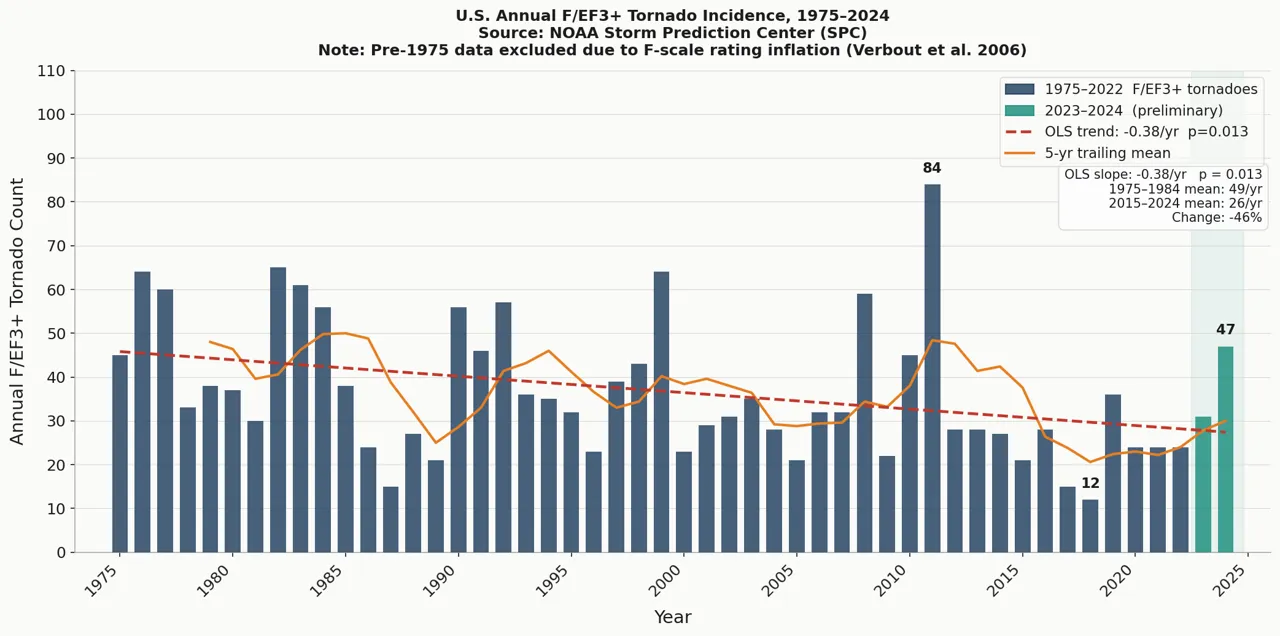
Focusing on the strongest tornadoes is important because prior to the deployment of Doppler radar in the 1970s many small tornadoes were never recorded if they happened in rural areas and no one was looking. But people tended to notice the major ones for fairly obvious reasons (like being blown from Kansas to Oz or worse) so the major-tornado time series is more comparable over time.
Pielke Jr. then reviews the main hypotheses that have been put forward in the science literature to explain this trend. Alas, the world is complicated and no one knows for sure. So all we can say firmly is that these charts will not be shown by the mainstream media. Indeed Pielke Jr. comments, referring to his Substack site, “I doubt you’ll come across these data anywhere else.” Probably not, which is why we think you should check him out and subscribe.


I used to live on a lake near Coatesville Indiana, the site of an F5 tornado in 1948, which literally removed the town from the face of the earth, that area is a tornado alley, you can see it in the landscape which is fairly devoid of large trees. Through the 1990s there were regular tornadoes in that area, mostly minor tornados, even this rate of tornados diminished since the Millenium. I know, anecdotal but we humans are mostly concerned with local weather since the weather in The Yukon or South Africa has very little impact on our lives.
When discussing major storm events one should take into consideration that very extreme events can occur naturally, albeit very rarely. Britain is completely outside the range of tropical cyclones, right? Except that one occurred in southern England in the year 1703, and is well recorded in contemporary accounts. Naturally if it occurred today it would be taken as irrefutable evidence of climate change, but this was in the depth of the Little Ice Age (and incidentally several years before the first steam engine was created).