
Forgive us for being fixated on Canada’s climate follies just because we live here. But they are revealing, including the U-turn on EVs that we mentioned last week where the government yanked the steering wheel so hard they did a 360 from banning gasoline vehicles by law to banning them by regulation. Raising the question whether they actually know what they’re doing and, if so, whether they regard themselves as commendably devious or just way smarter than everyone else. We hope not the latter because the policy is going to fail big-time. As Randall Denley just warned in the National Post, “To summarize, the Carney plan relies on electric vehicles (EVs) that Ontario plants don’t produce, a sudden and dramatic new appetite for buying EVs and an imagined export market that doesn’t exist. To top it off, the federal government will provide $2.3 billion in EV rebates that will encourage Canadians to buy cars made elsewhere”. Apart from that, a stroke of genius of the sort that, through decades of diligent effort, has made the nation tragically poorer without hitting any of our targets including the one where they get more humble.
As a Globe & Mail news story blurted out:
“A new study published Friday by the Canadian Climate Institute says Canada is not on track to meet any of its climate targets – not the 2026 interim emissions reduction target, the 2030 Paris Agreement commitment, or even the long-term goal of reaching net-zero emissions by 2050.”
Oh. Pretty hard to make that one sound like an achievement, isn’t it? Or to sound as if the people who pulled it off should be trusted with the next one.
Now as we’ve complained before, the “Canadian Climate Institute” bills itself as some sort of dispassionate neutral observer when in fact it’s a creature of the state. And, worse, one of those lavishly-funded outfits (we deniers may have all the money, but they got $30 million from the Canadian government and we did not… uh no, that was just one grant, the total’s higher) that exist to push the government to do things it wants to do anyway but needs the appearance of “civil society” support to pull off.
Thus, the Globe sonorously informs us, the problem isn’t that the targets were impractical or the politicians and bureaucrats inept. Heck no. As usual with Thomas Sowell’s “unconstrained vision” of public policy, all you need is love:
“The report suggests Canada has moved away from its climate goals thanks to ‘a slackening of policy effort over the past year, marked by the removal or weakening of climate policies across the country.’”
Which gives the impression they had been on track to meet their goals up until some recent backsliding, whereas in reality they have never shown any sign of meeting them. After all, what policies have actually changed since Carney took over as Prime Minister in ways that could possibly affect long-term trends? And how close was Canada to meeting “its climate goals” before this disastrous swerve into the camp of the deniers?
It’s not even true that “Canada” as a collective has collective “climate goals”. The government has climate goals, and they come bundled with a host of other policies at election time, especially since even our “Conservative” party is terrified of challenging climate orthodoxy. Public support for those goals is weak, sporadic and prone to vanish when real costs hove into view. But ignoring that piece of typical collectivist prose, Mark Carney has spent most of his prime ministership flying around virtue-signaling in the presence of others doing the same. (No, really. It’s been less than a year and he’s taken almost three dozen flights.) He hasn’t been in the office shredding this and demolishing that.
The Globe, in its fearless journalactivism that avoided interviewing anyone who might strike a discordant note, only people wishing to go further faster, protests feebly that:
“That ‘slackening’ includes the elimination of federal consumer carbon pricing, the conclusion of green home retrofit funding and the cancellation of the oil and gas emissions cap, the report says. Provincially, Alberta and Saskatchewan both weakened and suspended their industrial carbon prices, and Ontario repealed its climate accountability legislation.”
So is the claim that “federal consumer carbon pricing” had produced a big drop in emissions that suddenly reversed? Because if not, it has nothing to do with these trends. And surely nobody thinks Canadian “green home retrofit funding” was changing the weather except perhaps marginally inside the homes in question. As for the oil and gas emissions cap, it wasn’t yet biting hard so removing it can’t matter. And if you honestly think Ontario’s climate accountability legislation was doing something significant to Canadian GHG emission trends, you should not be permitted near sharp objects.
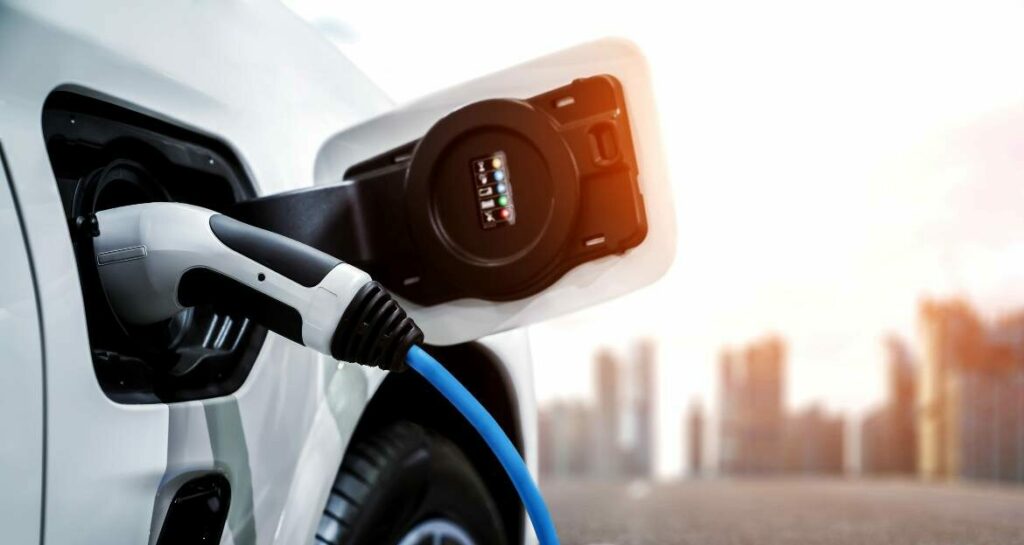
It is in this context of abysmal policy failure to the tune of much self-satisfied gum-flapping that one must assess Canada’s EV policies. Including the original mandate to force Canadians to buy no new internal-combustion cars by 2035. It was never going to work, so abandoning it won’t make it not work. But regulations that have the same effect in practice, by accident or by design, therefore also won’t work.
As Denley slices and dices it:
“Canada’s Ontario-centric auto manufacturing industry is a marginal player in EVs. The only ones it produces are the Dodge Charger muscle car and the Chrysler Pacifica minivan. Both are niche products priced above the $50,000 cut-off for Carney’s new rebate program. Carney is spending billions of dollars on rebates that are irrelevant to the Canadian industry.”
The Canadian industry being, evidently, something of which he knows little and cares less. As Denley continues:
“Carney’s plan also ignores a key fact. While he wants to step on the EV accelerator, the auto industry itself is hitting the brakes. Honda has delayed building a $15-billion battery and EV assembly plant in Alliston, Ont. Stellantis has sharply reduced its EV plans. GM has stopped production of its electric delivery van in Ingersoll, Ont. Ford dropped several electric vehicle models, took an US$19.5-billion write-down and switched its focus to gas cars and hybrids. Ontario manufacturing stalwart Toyota is concentrating on hybrids, not EVs.”
He adds that the car industry has been mostly positive because it got rid of that lethal ban on selling new traditional cars and light trucks at all. Which parenthetically tells you all you need to know about the traditional left-wing paranoia that governments dance to the puppet strings of big business; in fact firms grovel before an all-powerful state that can flick them into bankruptcy at will.
Or not parenthetically, because Denley further argues that while the original ban would have killed the auto industry in Ontario within nine years, regrettably the new version will do the same, just more slowly, a grim observation University of Guelph economist Ross McKitrick has also made.
In the Financial Post Bill Watson also goes after the policy and its rationalization. In the first place, he mocks the subsidies as being ineffective considering the average EV price is well above the cut-off at which vehicles are ineligible for subsidies. But it gets worse:
“[The subsidy] seems unlikely to cause a mass switchover to EVs (not hybrids!). So what will? The big, mainly hidden and therefore sneakier stick of emissions regulations. ‘More stringent Canadian GHG emission standards for model years 2027 to 2032 will … drive emission reductions in a technology-neutral manner while increasing the number of zero-emission vehicles on the road.’ But then the language becomes ominous and threatening. ‘Companies will be able to use a wide array of technologies to meet the standards in the early years and meet consumer preferences. However, a larger percentage of EVs will be required by all companies to meet the standard over time.’ No more hybrids: understood?”
Meet the new policy. Same as the old policy. Including complete cluelessness about market conditions, and their own limitations:
“Trudeau-style hubris lives! These folks still think they can foresee and largely run the future. “The future of the automotive industry is electrified and connected,” they declare. … Where will we sell all the innovative, Canadian-content EVs we’ll be producing?... The U.S. seems unlikely to take lots of the EVs Ottawa wants us to lead the world in producing — both because Americans have gone off EVs and permanent U.S. tariffs may soon disrupt the integrated North American industry. Will Europe or China?”
The hubris looms over it all. As Watson wraps up:
“I just don’t think the people who brought us the CRA and Canada Post will be of much help.”
In joining in eviscerating the Carney plan, Catherine Swift adds that in addition to all the other flaws:
“It is also clear that our current electricity infrastructure is nowhere near able to handle a majority of Canadians driving EVs. There will be a huge cost to upgrading our electrical grid to handle many more EVs, not to mention things like data centres and the planned “electrification” of other industries that currently rely on fossil fuels to generate electricity. The estimates for such a grid upgrade run into the trillions of dollars and will not happen quickly or easily.”
Or, based on the record, happen at all.
Somehow people have great difficulty accepting that those holding political power are often incompetent as well as misguided. Perhaps it would be better if they were merely pursuing the wrong plans well, because then they could pivot and do something important right. But story after story underlines the opposite, including from Blacklock’s Reporter the sadly unsurprising news that:
“The Department of Environment spent more than 10 years and $1.4 million building a ‘net zero’ garage in Whitehorse that it neither needed nor finished, say auditors. The project was commissioned by then-Environment Minister Catherine McKenna as proof her department could ‘lead by example.’”
It is typical that the project would be about appearances not results. But also that it would lead nowhere.




The only difference between where the entitled Spawn of Satan was taking the deranged dominion and where his former advisor is now taking the deranged dominion is through the effective use of his bought-off and conflicted media in lapping up the 1000 word diatribes that deliver the same climate hysteria-driven goals while following the verbal shiny objects intended to distract. The ideologically-driven economic vandalism will continue until the morale improves or the voting Eloi notice and question the decline.
A very interesting article. I have no problem imagining that Liberal Party policy developers are misguided or incompetent. That's a generous judgment given their ideologically driven failures of the last decade, the majority of which happened prior to the imposition of American tariffs. Our GDP per person was equal to that of the USA when Fidel's boy came to power. By 2024, it was and is now roughly equivalent to the poorest State in that Union. Canadians have the government we deserve. How long will it take for a majority to realize that Net Zero is industrial suicide, that the CCP is not a trustworthy ally, that a ruinous immigration policy is making home ownership impossible for younger Canadians, that cheap, reliable energy is essential?
It is a grift, it was always a grift. Sadly, Canada has become a ridiculous joke who is no bending over and handing the KY jelly back to China!
I'm just beside myself with anger today.After hearing that another Faux Conservative MP Matt Jeneroux "crossed the floor"!After winning elections four times since 2015,mostly by landslides.Though last time by about a 10% margin over his nearest challenger,a Liberal.How could he knock on doors as a Conservative,ask people to vote Conservative,ask people to donate their time,and yes money,on the pretense that he was a Conservative???He should have come clean when the last election was called,this guy is scum,just like the other lying turncoats.SHAME!!!