
From time to time we have turned our attention to the poor beleaguered polar bears… from a safe distance. These cute fuzzy white critters so beloved by the alarmists as long as they don’t have to live near any of them are supposedly disappearing due to climate change. And we say supposedly not just because we don’t trust alarmist slogans but because we do trust the data which shows polar bear numbers stable or increasing across the Arctic. But the news gets even worse for those hoping the big white predators could be tamed and turned into fluffy mascots for the green cause: polar bears are not just getting more numerous they are getting healthier, even in places where warming is happening faster than average. As Vox says when describing the new research, “Something very unexpected is happening to Norway’s polar bears.” Dang, nature turns out to be complicated again.
The BBC is surprisingly blunt about the supposedly settled science:
“Scientists expected the opposite, but polar bears in the Norwegian Arctic archipelago of Svalbard have become fatter and healthier since the early 1990s, all while sea ice has steadily declined due to climate change.”
But note that while admitting the fact, they deny the implication; climate change is melting the ice even if it’s not melting, and the bears will die in consequence even if they’re not dying.
Scientific American is also startled that their pet climate polar-bear theory, while true, is false:
“Svalbard’s polar bears are showing remarkable resilience to climate change/ These polar bears appear to be maintaining their physical health despite the loss of sea ice – their preferred hunting grounds”.
And they’re puzzling till their puzzler is sore:
“Polar bears are the poster children of climate change – and for good reason. These giant bears hunt, mate and spend their days hanging out on Arctic sea ice, which is rapidly disappearing as the climate warms. But some polar bears, it seems, are far more resilient than we realized: new research suggests that in one region, the bears are adapting to the declining sea ice.”
And for good reason. Except not. The new study was done by Norwegian, English and Canadian researchers and focused on the Svalbard region in the Barents Sea. Over the period from 1995 to 2019 over a thousand bears were tranquilized and captured, then weighed and poked and prodded to determine their overall health. And then released.
The health condition of the male and female bears respectively was as follows:
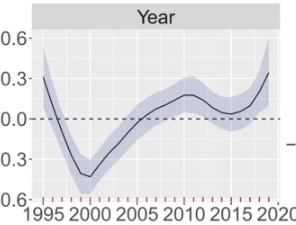
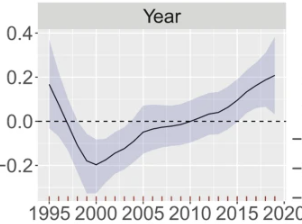
In both cases it dropped in the 1990s, just long enough for people like Al Gore to predict calamity, whereupon the trend promptly reversed and polar bear health has recovered to where it was 25 years ago when there was so much more ice.
While the study authors propose various explanations: more seals, a change in diet, easier access to plump western tourists coming to see the bears before they go extinct (actually we made that one up), they also admit that the results were unexpected:
“[Body condition] declined until 2000, but increased afterwards, during a period with rapid loss of sea ice. In models including sea ice metrics and climate (Arctic Oscillation), there was no support for the predicted negative effect of warmer weather and habitat loss. This indicates a complex relationship between habitat, ecosystem structure, energy intake, and energy expenditure. Increases in some prey species, including harbour seals, reindeer, and walrus, may partly offset reduced access to seals. Our findings underline the importance not to extrapolate findings across populations.”
What, don’t extrapolate? Nature is complex? What will they think of next? And what will alarmists think of as a new mascot? The Vox article laments that polar bears just won’t do anymore.
“No other animal has been so closely tied to climate change as the polar bear. It was on the cover of TIME’s 2006 global warming issue. It was featured in Al Gore’s seminal documentary An Inconvenient Truth, which premiered the same year. It was used in funding campaigns for environmental groups.... Ultimately, it’s easy for people to care about polar bears. They’re big, they’re fluffy, and they’re unique. So perhaps, instead of ditching them as a mascot for warming, it’d be better to acknowledge that the story is more complicated than it’s often presented. Climate change impacts the natural world differently in different places.”
What a tactful way of saying we have no idea what’s going on despite yelling that we did. But now maybe instead of trying to manipulate people into supporting your agenda with cartoons, mascots and misrepresentations, just start discussing the facts, even when they don’t line up with the alarmist dogma. Otherwise you may find your credibility vanishing faster than a hapless visitor who got too close to a polar bear.



Great weekly report. I appreciate the diligence and voracity of the writers/reporters involved.
For very good reasons there are 2 polar bears in the Peak District Wildlife Park in England. They look very happy in our temperate climate and in their huge enclosure. They are big and fierce so I’m glad they are at a safe distance!