
No, not the carbon budget. The carbonate budget, which is the production of calcium carbonate of which coral reef atolls and small island states are made. These would be the small tropical islands constructed by coral that are supposedly sinking in the rising seas of climate change, yet stubbornly refuse to get smaller and instead keep growing as the seas rise around them. How? As is so often the case with climate, it’s complicated. There are marine processes that lead to coral growth, and other processes that lead to coral erosion, and the net effect is called the carbonate budget. As a new study in the journal Geomorphology shows, that “budget” is anything but global and can even vary widely around the shoreline of a single island. And while those infamous “bleaching” events can harm reef formation, to the point that a 2016 coral bleaching event led to projections of the imminent submersion of the Maldives, this new study conducted in the aftermath of a 2024 bleaching event showed that overall that reef was still producing carbonate just as fast as the ocean was rising. The Maldives aren’t going under any time soon.
A coral reef erodes due to wind and wave action, and “bioerosion”, a polite name for chomping and defecating by parrotfish and sea urchins. Yes, these creatures eat coral polyps to get at the algae inside, nature being red in tooth, claw and beak below as well as above the surface, which is why if you watch those dazzling parrot fish in action you will hear a soft persistent scromping sound. And in the process they chew up a lot of coral and poop it out in the form of fine sand. So those dazzling soft white tropical beaches are mainly composed of fish poop. But don’t let us put you off enjoying your holiday.
Or them. If you find yourself stretched out on some nice fish poop on a reef flat in the Indian Ocean, do not let alarmists ruin your relaxation by telling you the atoll will be washed away by the rising seas. As is in one sense obvious, since the seas have been rising ever since the last glaciation ended and yet coral atolls are still at or above their surface because coral is alive and grows and adapts, even as parrot fish and other chomp away at its foundations, waves batter it and nature rages on.
Indeed the coral grows, or forms carbonate, precisely as the sea water washes over it. So the authors of this study picked seven zones on an active coral reef on a Maldive island and recorded the growth and bioerosion processes in the summer of 2025. Since it was in the aftermath of a large coral bleaching event in 2024 and the usual associated shouting, they expected to find net carbonate loss. Instead they found that, on average, the reef was adding mass and height at a rate adequate to keep up with changing sea levels. Almost as if coral worked that way as a rule, explaining why there even are coral atolls (not deep-water corals, but the colourful stuff):
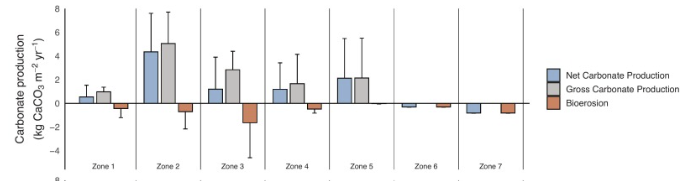
The Figure shows that carbonate production (gray bars) and bioerosion (orange bars) yielded positive net carbonate production (blue bars) in five of the seven zones, and averaged overall the net rate was positive.
“The reef rim and inner reef flat zones at Kelaihuttaa maintained a positive accretion state despite the 2024 bleaching event. Earlier studies from the same atoll reported a collapse in reef accretion state of −0.4 mm yr−1 at depths of 5 m on the forereef of lagoonal systems following the 2016 bleaching event (Perry and Morgan, 2017b). And these findings were subsequently used to infer a broader decline in carbonate budget states across the Maldives, suggesting a prolonged period of suppressed reef growth, with implications for reef submergence and increase [sic] island instability. In contrast, our data show a mean reef flat accretion rate of 3.4 mm yr−1, which falls within the range of pre-bleaching estimates... This rate is broadly consistent with the contemporary rate of sea-level change in the archipelago (3.68 ± 0.32 mm yr−1)”
Great news, huh? But don’t expect the UN types who love the drowning-Pacific-islands narrative for its visual shock value to celebrate it, and apologize for misleading the public. And don’t expect the media to step up on this one either. Both would rather let their reputations wash away with the morning tide than admit they were guilty of exaggeration. For our part, next time we find ourselves on a sunny tropical beach sipping a margarita we will quietly thank the scientists who are still in the business of carefully measuring things and reporting the numbers accurately, and the fish whose taste for algae made the sand on which we lie.

