
Yes, folks, we’re trying our hand at writing clickbait headlines like you see in the mainstream media. And how did we do? Did we make the situation sound dire? And did you notice we included the obligatory “experts say”? Or that we didn’t mention that the study in question (h/t Watts) actually found global rice production nearly doubled from the 1960s to 2015? And that rising CO2 levels played a big role, as did improved agricultural practices? So while it might possibly be the case that the warming caused a slight loss of rice production, that warming was itself, the theory insists, caused by extra CO2 in the air which was in turn caused by economic growth, and these caused rice production to soar ten times more than the heat caused it to decline. It was hard coming up with a headline that so completely misrepresented the data, but we’ve had lots of examples to copy from.
The journal article has the refreshingly blunt title “Management practices and elevated atmospheric CO2 levels helped to sustain a high level of global rice production”. And the authors begin by noting that:
“our study shows that rice production for 2006–2015 has increased by almost 2-fold since the 1960s, despite growing concerns about climate change and other extreme climate event risks.”
Concerns. But justified? Well, the authors looked at a number of key factors in determining harvests: the expansion of irrigation for rice fields, the expansion of rain-watered rice fields, the increased use of nitrogen fertilizer, CO2 growth and climate-related effects. And after pulling the data apart to reveal each component they graphed the results as follows:
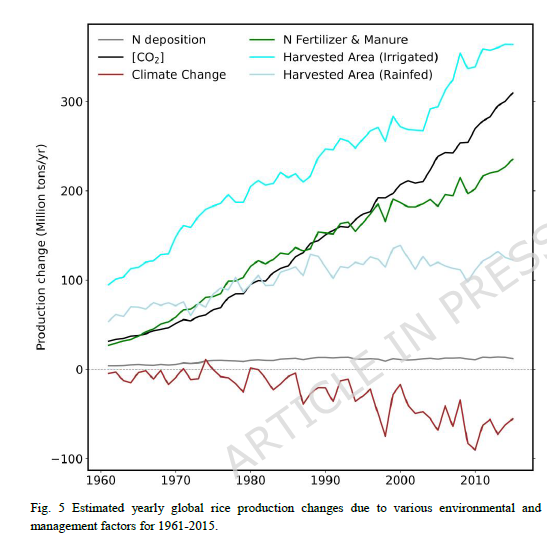
The vertical axis shows the calculated contribution of each factor to the change in rice production, in millions of tons per years. Including the red line trailing down, the supposed negative effect of “climate change” by which presumably they mostly mean warming. The black line sloping up is the effect of CO2 fertilization. And if we just consider those two together it is clear that the benefit of CO2 growth far exceeds the losses due to warming, so CO2 emissions are a net benefit for rice.
Of course the other factors add to the gains. The top pale blue line shows the effect of using irrigation to expand the available land for rice production. The green line shows the benefits of using more nitrogen fertilizer, which we note is another by-product of fossil fuels since nitrogen fertilizer is made with natural gas. The gray line underneath that is the benefit of adding land without irrigation, and it leveled off after 1990. But the gains from CO2 alone are real even if you believe the warming was bad for a cultivated tropical grass and that it is only stubbornness that leads farmers to grow it in warm wet areas and not, say, the Canadian prairies or Russian steppes.
Taken together the combination of good management, especially irrigation and fertilizer use, as well as the addition of a lot of CO2 to the air, has yielded an enormous benefit to global rice production. And since rice is the most important staple crop in the world, that translates into a lot of lives saved and people fed.
So pass the soy sauce and fire up that gas stove, we’re having rice tonight.


The +100 PPM increase of CO2 fertilization since 1960 could have increased rice growth by about +10 or +15%. Half of that gain could have been reduced by higher temperatures partially caused by CO2 emissions. CO2, including the net fertilization effect + the global warming effect, is positive for rice yields. But not as much as this article suggests.