
In this case “here” is the United States of America, a place that gets a lot of attention from those who live there and indeed those who do not. But it is just one country, albeit a big and dynamic one. So when journalists and activists (but we repeat ourselves) treat a hot March there as proof positive of runaway global warming, we have to object. As did Anthony Watts at Watts Up With That, writing “Media outlets are screaming ‘climate change’ over the US’s record March heat, but here’s the twist: North America was actually below average by -0.40°C.” So why is neither unusual cold in often-overlooked Canada, or unusual cold for all of North America which includes that other place, unworthy of mention?
Roy Spencer, courtesy of WUWT, goes a bit further into this anomaly. Using his and John Christy’s iconic UAH satellite data set, he shows that the departure from the 30-year linear temperature trend for the US in March 2026 “was easily the record warmest of all months in the 47+ year satellite record: +3.7 deg. C above average for all Marches”. And it’s far and away the largest such departure, either way, in any regional box on the table of monthly regional figures since January 2024. So it’s anti-representative.
Indeed, if you look at the figures for March 2026 it’s 1.14 for Australia, but -0.48 for the Arctic, 0.07 for the Tropics, 0.42 for the Southern Hemisphere as a whole, 0.33 for the Northern Hemisphere as a whole, and 0.38 globally. What’s more, the global figure is below all but three months since January 2024, and those three were all since July 2025. Not exactly runaway warming, now is it?
The tendency to ignore the fact that this highly-touted “global” warming is severely localized brings up something that’s been a sore point in the debate over global warming for more than a decade. Specifically, the people who initially said it was happening, we were causing it and disaster would surely ensue if we did not mend our ways, then redefined it as “climate change” because the globe wasn’t warming the way they predicted. The strange result was that they could continue to say we were causing it and disaster would surely ensue if we did not mend our ways without being very clear what it was or even when it had happened, was happening or will happen, so it was very hard to tell what exactly they were predicting and how we could test it.
Which brings us to a question that’s been increasingly on our minds lately, one for both sides in the climate debate: What, if anything, would cause you to change your position? For the skeptics, what if the entire planet were experiencing this kind of spike? And for the alarmists, what if it weren’t?
What, indeed, could possibly count for them as contrary evidence when the New York Times “Climate Forward” could write in February 2026:
“What’s Up With This Big Freeze? Some Scientists See Climate Change Link/ A warming Arctic can stretch the polar vortex, a high-altitude air ribbon, one says. The ‘wobble’ can disrupt the jet stream, causing extreme cold in the East.”
And then a month later a Times columnist can declare heat in the US proof of climate change. But of course a month earlier the same writer had inspired the headline “Climate Change Is Fueling Extremes, Both Hot and Cold”. So anything counts. Which means nothing does.
Our own view is that as climate is simply a statistical description of weather conditions in some region over 30 years, to establish that the Earth were warming you’d need long, reliable time series, not one hot month, year or even decade. But to establish human responsibility you’d need a lot more.
For starters, to establish that CO2 was either a direct cause or direct consequence, you’d have to show that warming worldwide fit the atmospheric CO2 curve quite closely, so spikes would actually undermine that part of the theory. And then you’d need to prove CO2 was cause not symptom, and moreover that the increase in CO2 was due to human activity.
So OK, we’d take some persuading. But what about the other side? What evidence would be required to stop them from thinking everything bad is due to man-made CO2 and will keep getting worse, so that a brief anomaly in one reasonably small part of the Earth is definitive, shriek-in-your-face proof of a long global trend we did? If any.
P.S. We note that, as far as can be determined, Nuuk in Greenland has seen no warming at all since 1958 though it has seen some fluctuation (loosely down, then up, then flat). And certainly it’s unlikely to be experiencing an Urban Heat Island although as Greenland’s capital it actually has over 20,000 people.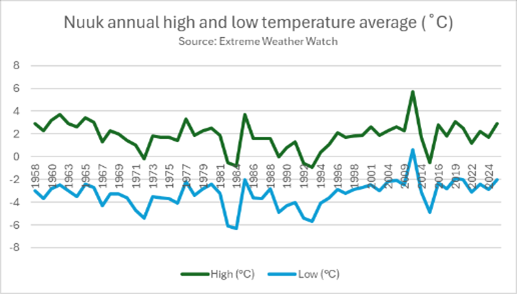


Speaking of local or regional effects, consider the medieval warm period. Alarmists say that it was a regional phenomenon (ignoring evidence from all over the globe). But shouldn’t the warning shot which they are alarmed also be considered a regional effect (in the industrial Atlantic region) given that most of the world has no historic weather records at all?
“Warning shot” s/b “warming”
Thanks for the summary review. I appreciate that. Isn’t the evidence stronger that increased CO2 levels are a consequence or symptom of an increase in temperature (albeit very small) rather than a cause. And just a side note for those who would seem to imply otherwise, human activity has always produced CO2, since humanity’s first breath - in case you hadn’t noticed.
"you’d have to show that warming worldwide fit the atmospheric CO2 curve quite closely, so spikes would actually undermine that part of the theory." ??
Scientists detect acceleration in global warming after 2015 (global warming correlates well with CO2 emissions when you look at 10 year averages after 1975)
... natural spikes and flat spots on the temperature record are caused by the el nino and la nina (enso), temperature neutral in the long run of 50 years