
Last week we discussed some new research connecting “excess” warming in Europe, excess being a word here meaning CO2-driven climate models can’t explain it so it must be something else, with reductions in sulphur dioxide emissions. This week we look at an alternative explanation, although they are not mutually exclusive: more sunlight hitting the surface. Before we get to those numbers, please note these ones. First, the IPCC figures that all the CO2 that’s ever been emitted since 1750 has added about 2 Watts per square meter of heat energy at the Earth’s surface. Second, it figures that methane and other greenhouse gases have added about 3 Watts per square meter more. Third, therefore, the total increase due to CO2 and other greenhouse gases is about 5 watts per square meter. Fourth, they say there’s been a cooling effect due to aerosol pollution of about 2 W/m2, which leaves a net gain of about 3 of those cumbersome units. And fifth, necessarily, because that is the total gain measured empirically, the IPCC therefore says the sun has done precisely nothing. But wait. The other important number here is that people have been measuring the amount of solar energy hitting the Earth’s surface for some time using satellites in combination with ground stations. A new study looking at the record just for Germany found that since 1995, the year all the satellite systems came online together, more solar radiation has been hitting the surface. So much more that the trend since 1995 is about +4 watts per square meter per decade, hence a 25-year total increase of around 10, double the effect of all the greenhouse gases ever emitted. With all that extra heat energy from the sun there’s nothing for CO2 to explain. Indeed, less than nothing, because we have to get down from that 10 to just 3. Something doesn’t add up.
The study was conducted by four scientists at Deutscher Wetterdienst, the German government meteorological service. Their results are as follows:
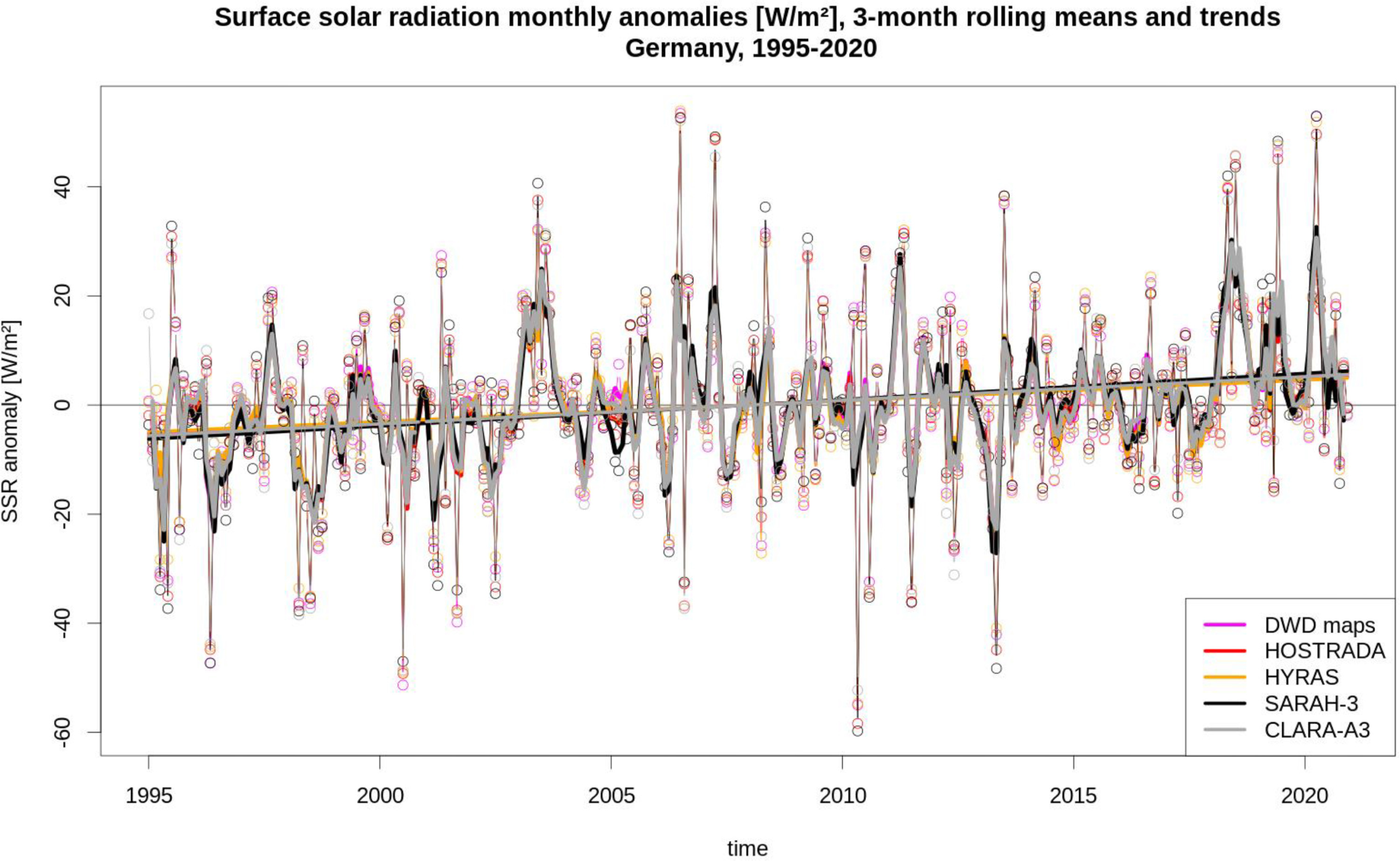
As noted, the graph shows Surface Solar Radiation (SSR) in watts per square meter relative to the 1995 to 2020 average. The trend is +4 watts per square meter per decade. Over the sample interval that adds up to a lot of radiative forcing. Moreover, many of the same authors were involved in a 2024 study that used one of the satellite products (SARAH-3) and estimated trends over the whole of Europe from 1991 to 2020 and the result, while more variable over a wider area, is the same in the big picture:
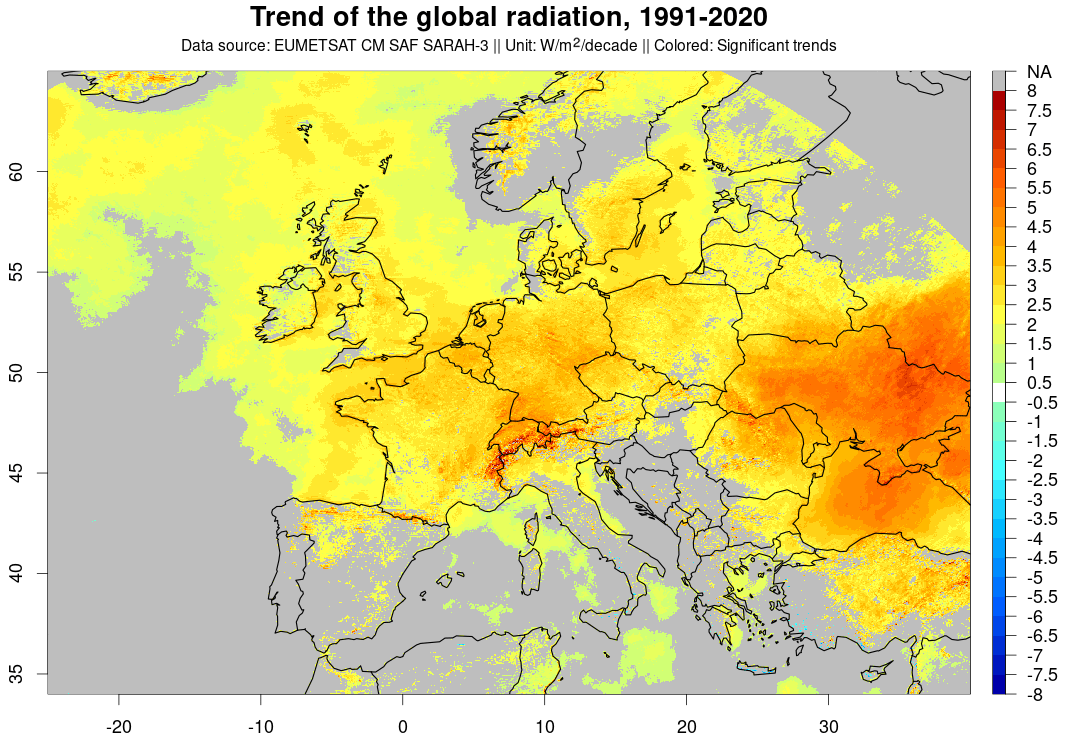
The vertical colour code shows that the upward trend in SSR ranges from about 2 to about 5 watts per square meter per decade depending on location. Again, far more than attributed to all the GHG emissions ever recorded.
Also, again, a puzzle in that we’re actually getting more of an increase in SSR from this one potent source so instead of there being even a residue to attribute to CO2, methane and other human greenhouse sins, we must identify a mystery actor decreasing the net total. What can it be?
Actually, first things first. What’s the cause of this increase in SSR? And the authors of these papers don’t actually offer an explanation but others have explored possibilities. For instance, as we reported this spring the DOE Red Team report last year reported that the Earth’s global albedo, its reflectivity, has been declining which means less incoming solar radiation gets reflected away and is instead absorbed at the Earth’s surface.
So the effect isn’t just confined to Europe, although it seems especially strong there. And there is almost certainly a connection to cloud cover which dropped globally after 1995, for reasons that appear to be connected to cyclical changes in the Pacific ocean not, again, CO2.
Alas, climate science isn’t like the other kind. So the skies are less cloudy, more sunlight gets in, and in Europe the effect over the past 25 years has been at least twice as strong as all the greenhouse gases emitted since 1750. But the IPCC assumes the sun doesn’t contribute to global warming.
This topic needs a lot more sunlight on it.


This article confuses weather and climate
Evidence collected over the past fifty years strongly suggests co2 emissions are stronger cause of warming than reduced albedo from reduction of air pollution
In addition, CO2 emissions are on a rising trend while the reduction in air pollution is in a declining trend. The small decrease of air pollution from 2025 to 2026 cannot explain why there is hot weather in Europe this summer
Richard neither does CO2. And one swallow does not mean it is springtime as the saying goes.
Not at all Richard. But maybe you can explain why you think this. What's your "evidence collected" And, by the way, that article was not about 2025 and 26.
Here, Alfred. Now tell me if YOU'VE done any critical thinking about the claims in this article, or if you reflexively believe what it says because it supports your narratives, false or not.
<>
So no, not "caused by" aerosols.
CO2 definitely has a much stronger correlation, especially since, as Richard points out, aerosol reduction has slowed in the past decade, and the average temperature in Europe keeps rising.