
We have complained many times that the public is presented with a picture of climate science systematically biased towards alarmism. And it’s not just our anecdotal impression. We have data, in the form of a new study from the US National Bureau of Economic Research saying the government delegates who write the IPCC Summary for Policy Makers (SPM) overstate the science in the underlying report, and then the media further overstates what’s in the SPM. The study authors used multiple AI systems to extract key scientific statements in every IPCC Assessment Report since 1990, track how they were summarized and what the accompanying media coverage said. Using a statistical model they measured the way the statements get changed or twisted at each stage. There were some surprising results and some unsurprising. Unsurprisingly the data showed the UK Guardian has by far the most climate coverage of all major media outlets and is also the most biased. Another unsurprising result is that the overall media bias regarding the severity of climate change has been consistent over time. A surprising result (to many, but not to us) is that the only major media outlet exhibiting precisely zero bias was Fox News. Otherwise most right-leaning outlets adopted the left-leaning outlets’ alarmist bias as of 2007, again unsurprising to us. And there’s much more.
The authors identified three forms of bias: severity, in which a summary picks the upper end of a range of claims, uncertainty, in which a summary downplays caveats and qualifiers, and scenario in which worst-case scenarios get foregrounded. They used a numerical scale from -2 to +2 that captured bias in either direction: a positive number indicated that the summary was biased towards alarmism and a negative number indicated a bias in the opposite direction. Then they averaged the bias measures together and measured them at two stages in the game of telephone. The “TS-to-SPM” stage compared statements in the author-written Technical Summary to how they were worded in the government-written Summary for Policymakers. The “SPM-to-media” stage looked at how statements in the SPM were then reported in the press. The authors examined the TS-to-SPM stage for every IPCC Assessment Report from 1990 to 2023. They only looked at the SPM-to-media stage from the 2001 Third Assessment Report (AR3) because that’s as far back as their media library went.
There were three main findings.
“First, the TS-to-SPM stage reweights severity upward in every Assessment Report from 1990 to 2023.”
That’s right, folks. The IPCC’s SPM process has been generating biased summaries since the IPCC began. Government delegates have been twisting the science in the alarmist direction for over thirty years.
“Second, the SPM-to-media stage shows the same upward reweighting across the four cycles we measure, AR3 (2001) through AR6 (2021 to 2023).”
That’s right, folks. To no one’s surprise, the media has been amplifying the bias further since 2001 (and probably earlier but the data weren’t available).
“Third, across the panel of ten outlets, left and right-leaning groups show similar patterns. At both stages, the shift comes mainly from emphasizing higher-impact magnitudes within reported ranges, less from uncertainty compression, and almost none from selecting worst-case emissions scenarios.”
That’s right, folks. Even the right-leaning outlets have also gone in for alarmist bias, at least since 2007. Indeed, the media’s bias converged in size and direction over time, as shown in this chart:
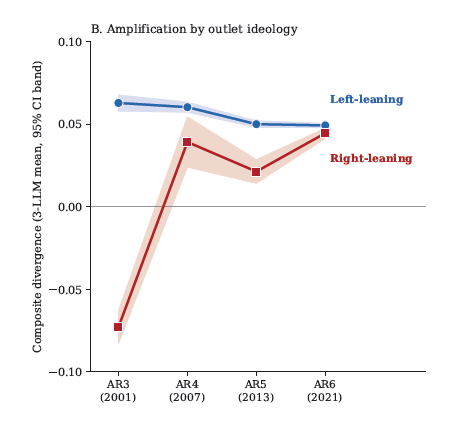
For the AR3 in 2001, right-leaning outlets on average understated the climate findings while left-leaning outlets overstated them. But thereafter both sides shared the alarmist bias. Which reflects the success of alarmist activists in the post-An Inconvenient Truth era (2006) driving skeptical voices out of the media. That campaign didn’t eliminate bias, it only replaced one form by another, with the result that the overall media landscape became entirely one-sided.
The uniformity of the bias can also be seen in this chart:
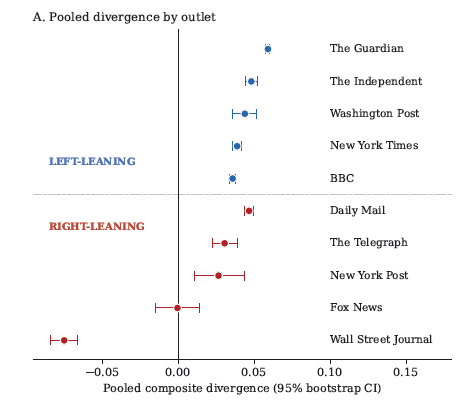
The right-leaning outlets in red are about as bad as the lefties in blue, except for Fox News which is the only outlet with no measurable bias and the Wall Street Journal which had an overall negative (anti-alarmist) bias.
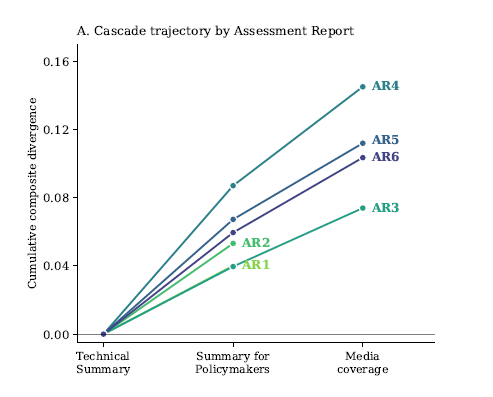
The authors also describe the “amplification cascade” by which the bias at the TS-SPM stage is amplified, rather than corrected, at the SPM-to-media stage. It has existed across the whole 30 year time span, as shown in this chart (and remember, the higher the positive number the larger the overall bias):
One of the snarky rejoinders from alarmists when skeptics complain about biased reporting on climate issues is that there couldn’t possibly be a conspiracy because so many different people are involved. Which calls to minds the wise words of Thomas Sowell at the beginning of his masterful A Conflict of Visions about the curious way in which opinions on apparently diverse issues tend to sort themselves into left and right:
“It happens too often to be coincidence and it is too uncontrolled to be a plot.”
Or as a former colleague commented to one of us about supposed media conspiracies, anyone who’d ever worked in a newsroom would know journalists are too disorganized to plot. So how are we to explain the fact that both the government staff and the world’s press both share the same bias in the same direction, and the slopes of the lines show that the government bias is even stronger than that of the press?
The answer is that the bias is shared widely by the people who have flooded into the climate change blob either as bureaucrats or “reporters” and who as a result have a direct interest in keeping the scare at a maximum.
The Cascade trajectory chart shows that the TS-to-SPM bias was smallest in the early days (AR1 to AR3), peaked in the AR4 (2007, right after An Inconvenient Truth) and has backed off a bit since them. The SPM-to-media bias was also worst for the AR4 and has eased off a bit since then but was just as bad for the AR6 in 2023 as for the AR5 in 2013. It’s an entrenched mindset, a belligerent one and an unreflective one.
The authors speculate that the TS-to-SPM bias arises because government delegates are “risk-averse” and the potential criticism bureaucrats face from overstating a problem, any problem, not just in climate, is less than that of understating it. Which may indeed be part of it, but frankly doesn’t explain why the bias stays so strong after 30 years. A better explanation is that the denizens of the green blob know that their fat paychecks and annual junkets to climate gabfests depend on the public being kept in a permanent state of panic. And they know that the press won’t call them out on it because the press is in on it.
And now we know. The science is settled. At least if you believe in that there evidence-based decision-making.


The IPCC was created to scare people about global warming and blame global warming on man-made CO2 emissions. Doing just that since 1988.
IPCC = Intergovernmental Panel on Climate Change. They tell you in their title that it's a political organization and as such, is biased. Therefore the IPCC should always have been recognized as having a particular agenda to push: alarmism for control and the greatest wealth transfer in human history.
The Good News from all of this is that eventually the Alarmists will be proved wrong, the only trouble is that the media will keep lying to us!!