
In a blockbuster post at his Substack, Roger Pielke Jr. breaks the news that the elves in the IPCC factory who generate emission scenarios to feed into computer models have decided that, for the next IPCC report, they will finally drop the extreme RCP8.5 scenario and its SSP5-8.5 spawn, having concluded that they are “implausible”. Yeah. No kidding. We knew in 2020, and said it, as did a lot of observers. And while Pielke Jr. applauds the IPCC’s decision, we have little interest in praising them for their newfound scientific probity. They’ve known for a long time that they were pushing a phony scare, and that tens of thousands of “climate impact” studies based on RCP8.5 were bogus, leading to tens of thousands of overhyped media nonsense items all of which they would now call on to be retracted if they were interested in being truthful, and an enormous wave of wasteful government spending based on this induced panic. And it gets worse because, even with their quiet retreat from RCP8.5, the IPCC is still clinging to other exaggerated scenarios. They’re a long way from deserving praise.
The report from the so-called Scenario Model Intercomparison Project or ScenarioMIP drops the admission thickly padded by this noise- and attention-muffling bafflegab (emphasis added):
“As a set, the ScenarioMIP scenarios should thus cover plausible outcomes ranging from a high level of climate change (in the case of policy failure) to low levels of climate change resulting from stringent policies. For the 21st century, this range will be smaller than assessed before: on the high-end of the range, the CMIP6 high emission levels (quantified by SSP5-8.5) have become implausible, based on trends in the costs of renewables, the emergence of climate policy and recent emission trends (Hausfather and Peters, 2020). At the low end, many CMIP6 emission trajectories have become inconsistent with observed trends during the 2020–2030 period.”
It’s not just soporific, it’s untrue. Because as Pielke Jr. notes, RCP8.5 and SSP5-8.5 have not “become” implausible, and their status certainly hasn’t changed due to policy success or the declining costs of renewables. They never were plausible. Not even remotely. And what policy success? Or declining costs of renewables?
The IPCC report has 44 authors, all who believe themselves capable of predicting the world in detail a hundred years from now yet who remain completely incapable of describing it today. Which deserves hissing and wagging of the head, not applause.
To get all technical, which surely is the IPCC’s job or should be, RCP8.5 was absurd from the beginning because it proposed a simultaneous collapse of the world economy due to scorching heat and massive global expansion in coal use, the latter being doubly impossible because it was incompatible with known estimates of global coal reserves. Yet when that scenario finally became laugh-out-loud non-credible, SSP5-8.5 carried on the wheeze. Pielke Jr. shows the situation in the following figure:
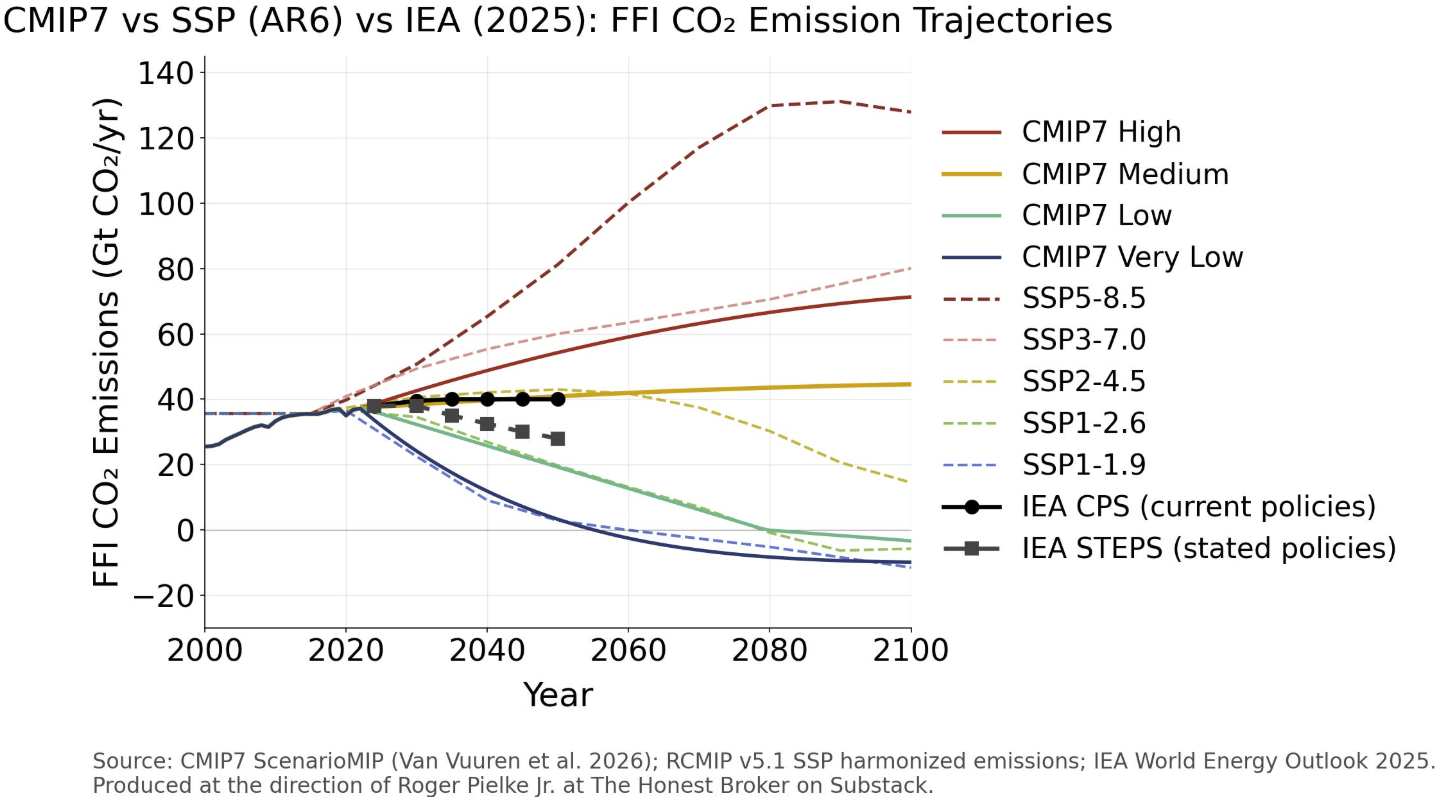
This graph shows actual and projected annual global CO2 emissions from fossil fuel use and industry. And the dashed lines are the now-obsolete SSP scenarios. The solid lines are the new supposedly-credible scenarios and the black indicators are the projections from the International Energy Agency.
The highest dotted line is SSP5-8.5, which matches the RCP8.5 outcome on which almost all “climate change impacts” studies over the past decade, and certainly all the impacts studies you ever heard about in the media, were based. The next lowest is SSP3-7.0. And immediately below it is “CMIP7 High” which the Scenario elves now call the “high end” of the plausible range. Its annual emissions are less than half those of SSP5-8.5, meaning the IPCC now admits its most heavily-promoted scenarios over the past decade assumed emissions more than double what it now admits is the maximum plausible rate. But look how closely it tracks SSP3-7.0.
As you know, these scenarios were intended to be scary. And indeed they are. But not because climate change is scary. Because the scientists whose job it is to tell us about it spent a decade promoting what they knew was an obvious fiction even long after they had been called out on it. And even after admitting it, they’re carrying on.
As RPJ observes:
“Tens of thousands of research papers have been – and continue to be – published using these scenarios, a similar number of media headlines have amplified their findings, and governments and international organization have built these implausible scenarios into policy and regulation. We now know that all of this is built on a foundation of sand.”
Speaking of sand, the new (CMIP7) Medium scenario is the one in yellow, and it overlaps with the IEA “current policies” scenario, which assumes business-as-usual with no further climate policies. But even those projections may be exaggerated because, as Pielke Jr. notes, the scenario writers are using assumptions about population growth well above mainstream demographic estimates, which take into account the world’s ongoing fertility crash. So take out the new High scenario and put it in the same bin as RCP8.5 and SSP5-8.5.
When you do, what remains is a moderate emissions path which will result in modest, non-alarming warming even if you accept the IPCC’s climate sensitivity assumptions. It’s over, folks. But don’t expect to learn that from the IPCC. They’ll be clinging to their alarmist exaggerations until the next glaciation when they and their media enablers will be entombed in ice wrapped in CMIP7 High.


pielke was really fooled by this announcement & didn't understand what it meant
since 1988 the IPCC has used a wide range of scenarios to guess the future climate
the range of guesses has narrowed in recent decades but they always seem to come up with the same average of +3 degrees C. warming per CO 2 * 2. ... that 3 degrees warming guess was first published in the 1979 charney report .... if this trend continues in the next IPCC report in 2029, i bet they'll still be claiming +3° per CO 2 * 2 ... all we really know about the climate in 150 years, which is how long it will take CO2 to double, is that the climate will be warmer by some unknown amount, but we don't even know how much more CO2 will be emitted in the next 150 years (the climate will be warmer in 150 years, unless it is cooler = that's my prediction)