
At least that’s our take on a new study in the Proceedings of the National Academy of Sciences, h/t No Tricks Zone. The authors don’t put it that way, but it seems to be what their numbers have shown. They start with a simple statement of the Earth’s energy budget: N = F+R. F is radiative forcing, which according to the IPCC is the tendency for the atmosphere to heat up due to solar radiation that arrives and does not leave again, mainly due to increased CO2. (They define it as “The change in the net, downward minus upward, radiative flux (expressed in W m–2) due to a change in an external driver of climate change, such as a change in the concentration of carbon dioxide (CO2), the concentration of volcanic aerosols or the output of the Sun.”) R is a feedback called the “radiative response” or tendency of the Earth to send more energy to space as it warms, thus to amplify or counteract a rise in F. N is the net change which drives the overall warming response to increased greenhouse forcing. It is measured using ocean heat content. F and R can’t be measured directly, but they can be computed using models. OK, skip forward: what the authors found using a new long-term set of estimates of N, F and R is that N used to change in step with F, meaning R was constant and an increase in forcing caused a proportionate increase in warming. But since 2000, they’ve been diverging and now there’s a lot less warming compared to the increase in forcing. R has declined such that Earth simply doesn’t warm as much anymore in response to increased forcing. No one knows why: climate is very complicated after all. But the finding means a lot of climate models are wrong and will warm too much in response to projected future greenhouse gases.
To do the study the authors had to construct long-term estimates of forcing F, radiative response R and net change N. They used the IPCC model-based estimates of forcing F and observed temperatures and some modeling assumptions to estimate R. For N, since ocean-heat content data only goes back to the 1960s, they instead constructed a model of how heat diffuses through the layers of the ocean then fed in observed historical sea-surface temperatures, which allowed them to estimate N back to 1880. Despite all the modeling and assumptions and short cuts, the numbers worked out: F and R added up to N, sort of. Within uncertainties as they say.
And when they plotted the numbers they saw a surprise:
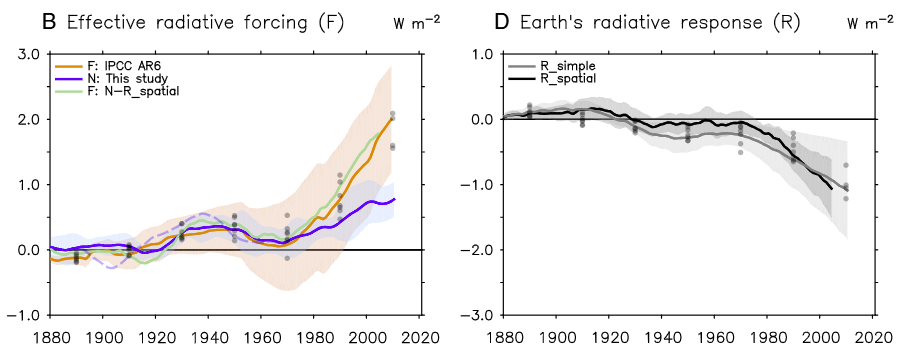
In the left panel the orange and green lines are, respectively, the estimates of F from the IPCC and from using N minus R in their new approach. And they agree pretty well. The blue line is N, the climate system heat uptake rate. Up to 1980 it tended to track F closely. Then after 1980 F rises quickly but heating doesn’t. The heat is going away somewhere. On the right is the graph of R, which they compute two ways, hence the two black lines. After 1980 both veer downward, which in modelese means the Earth is much more efficient at shedding heat to space. Up to 1980 about 100% of the energy from increased radiative forcing went into warming the climate system. But after 1980 that proportion dropped to about 40%.
What’s going on? We don’t know and if the authors of the study do they don’t say. It’s almost as if the climate system has a negative feedback mechanism, or set of same, working to keep things stable even when something changes like extra greenhouse gases. Which means if climate models don’t include that process their projections will be wrong. They’ll project warming to look like the F lines on the left, whereas it may end up more like the N lines.
It's one of those things that may turn out to be nothing, or a big error, or a revolutionary new insight. And it’s another reminder that with something as complex as the Earth’s climate, the science is never settled. And that normally in science, an unexpected finding is an exciting harbinger of a possible “Eureka” moment, not an unwelcome guest to be mentioned in hushed terms and evicted as quickly and quietly as possible.


It is a common sense answer. As things heat up above the surrounding ambient, the the rate of heat radiation (cooling) increase. Any uneducated person knows hot thingd tend to cool faster based on the difference between the item and surroundings. It takes a highly educated person to forget that.
"Up to 1980 about 100% of the energy from increased radiative forcing went into warming the climate system. But after 1980 that proportion dropped to about 40%"
Complete nonsense! The statement is a misinterpretation of how the Earth's energy budget has changed; in reality, the ocean has absorbed over 90% of the excess heat from increased radiative forcing over the past half-century. The efficiency of the ocean's heat uptake has increased, but the total amount of energy being stored in the climate system (primarily the ocean, not just surface warming) has dramatically accelerated, not dropped. The rate of ocean warming has more than quadrupled since the late 1980s, not decreased. This increased efficiency in moving heat into deeper ocean layers has actually delayed the full extent of atmospheric surface warming. Total manmade CO2 emissions have increased in every 10 year period, starting with 1975 to 1985 (vs. 1985 to 1995, 1995 to 2005, etc.). Each successive decade since 1970 has been warmer than the last, and the overall rate of warming has accelerated compared to the pre-1970 period. The measurement that oceans absorb over 90% of excess heat involves a global network of scientific instruments and data analysis, primarily relying on robotic Argo floats that measure ocean temperature and salinity at various depths. Argo floats started systematically measuring global ocean heat content in the early 2000s, with global coverage of the upper 2,000 meters achieved by late 2007. The program began in 1999, and data has been collected continuously since the first deployments.