
Does anyone remember the Stern Review of 20 years ago? You should, because along with a handful of other wrong but highly influential products of 2006, like Al Gore’s movie, it is a key reason we can’t have nice things anymore. It came about when Sir Nicholas Stern, up to that point a UK government economist who admitted to knowing nothing about climate change, was tapped by then-UK Prime Minister Gordon Brown to write a report on the economics of climate change. Stern wandered over to the Climatic Research Unit at the University of East Anglia, then in its pre-Climategate glory days, to get briefed on the science, and came out a swivel-eyed alarmist zealot. His report concluded: “The scientific evidence is now overwhelming: climate change is a serious global threat, and it demands an urgent global response” and included all the usual breathless verbiage about there being only a limited amount of time to act before calamity strikes. Among the many people taken in by it all was none other than Mark Carney, who would later quote Stern approvingly as he used his perch at the Bank of England to launch his own climate crusade. Stern concluded that the impacts of climate change “would be equivalent to losing at least 5% of global GDP each year, now and forever”, and if that suspiciously round number didn’t scare you, they could tweak the numbers up to 20%. You want it, you got it. But as Roger Pielke Jr. reports, and exposed at the time, Stern’s numbers depended on a misreading of an unpublished paper about disaster loss trends, and a simple check of the report’s projections against reality show how wrong he was. But as usual in climate science, unlike the other kind, being wrong doesn’t seem to matter.
Stern’s economic model assumed that weather disaster losses as a fraction of Gross Domestic Product would grow by 2% per year because extreme weather was getting so much worse so quickly that it was outpacing economic growth and would soon crash the economy. Pielke Jr. remembers the details well because he had organized a workshop in May 2006 convening 36 experts in disaster losses to help the insurance industry understand climate-related trends. The participants unanimously concluded that trends in disaster losses were due to trends in population and income, not climate, and that it was “not possible to determine the portion of the increase in damages that might be attributed to climate change due to GHG emissions.” Gordon Brown did not call them.
Stern sort of did and it was worse than nothing. You see, one of the papers presented at that workshop, according to Pielke Jr., found no trend in disaster losses as a fraction of GDP over 1950-2005, but over the shorter interval 1970-2005 it found a 1% upward trend, which Pielke Jr. argued was due to low hurricane numbers in the 1970s and the 2005 Hurricane Katrina falling at the end of the period. And Stern somehow misread that paper to conclude that global disaster losses were rising 2% faster than GDP, and then extrapolated forward to claim the rate would go up to 3%, 4%, 5% and eventually 6%.
By means of this basic error Stern was able to predict massive economic losses in the coming decades from climate change, while also projecting minimal costs from a radical transformation of the UK economy away from fossil fuels. At the time many experts rubbished the report’s economic analysis (see here, here, here and here, for example) but just because it was wrong didn’t mean it wasn’t politically useful, and it was received with great huzzahs in the halls of power.
Which was bad enough though again evidence to us of zealotry not fakery. What’s worse is what followed when reality didn’t fit hysteria.
So, first, how did Stern’s projections of disaster losses as a fraction of GDP compare with subsequent reality? Pielke Jr. shows the numbers:
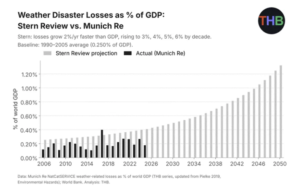
Not a pretty picture. In only one year out of 20 (2017) did actual losses as a fraction of GDP exceed Stern’s projections, rather than trending up they have remained flat, and over 20 years the total reported losses were 40% below Stern’s projection. So the powers that be, including the current British Secretary of State for Energy Zero, are lavishing praise on Stern for his foresight.
Oh well. Perhaps the good people of the UK who lost access to affordable heating fuel due to such modeling blunders could stay warm this winter by burning all their old copies of the Stern Review.
