
Climate alarmists put high hopes on the 2026 El Niño to deliver catastrophes. And if not those, then at least excuses: the Palm Beach Post, part of the USA Today chain, asks plaintively “Florida’s peak hurricane season is here, so why is the Atlantic silent?” And then it explains, doom looming as always, that “A key culprit in this year’s hurricane drought is the deepening El Niño climate pattern, which is sending a firehose of wind shear through the Caribbean to kill embryonic systems and hobble those that do find a fleeting purchase.” Culprit? Who searches for a culprit when a horrible storm doesn’t destroy your house and kill your neighbour and their cat? Climate alarmists, that’s who. And they must, since if they keep warning that the weather is getting more and more horrible and then it fails to deliver, it must be due to horrible weather with bad motives. The one bright spot for them is the recent heat, allowing the CBC to shout triumphantly “August was Earth’s hottest month, European climate agency finds/ ‘This is the spiralling price of humanity’s fossil fuel addiction,’ says UN’s climate chief”. Whereas if they made even a small attempt at consistency by, say, reading their own breathless El Niño coverage, they’d have to admit that a hot August is due to non-climate factors so there’s less “global warming” than there seems to be. But since good news is bad news for them, don’t hold your breath.
They’re definitely not happy about the hurricanes. Indeed MSN recycled a story from The Independent with the headline “There could be no Atlantic hurricanes this year – but there’s a catch”. And would the catch be that you told us climate change was making more and worse hurricanes inevitable? Heck no.
Instead hope springs eternal, with the New York Times muttering “While the inactivity is unusual, meteorologists said it is explainable – and they warned against confusing a quiet start with a quiet finish.” And The Independent finding solace in “The trade-off to a potentially historically inactive Atlantic has been a super-active Pacific hurricane season, which is a hallmark of El Niño.”
Actually the Pacific season has been active but not “super-active”, at least in that so far it’s slightly below the cumulative average for both hurricanes and major hurricanes though of course with over a month to go. But a few years back when there was a lot of that stuff in the North Atlantic they called it the new normal, proof positive blah blah blah.
What’s happening now instead? Well, as Roger Pielke Jr. wrote in a Sept. 11 note to subscribers, for the North Atlantic we’re seeing:
“a record low for the date. The Atlantic basin has generated 4.4 ACE units through September 11, versus a climatological average near 60 units to date, with five short-lived named storms and no hurricane. The inactivity of 2026 has never before been seen.”
Now here at CDN we’re very cautious about words like ever and never. But we checked on the relevant new RPJ “data dashboard”, the one on “Global Tropical Cyclones” built with Ryan Maue, and for starters the data goes back to 1851, though of course it gets less complete as well as less reliable as you go back. Before the aeroplane, let alone regular passenger flights to say nothing of satellites many storms at sea were not spotted at all, let alone reliably measured.
That caveat entered, on Sept. 12 the Atlantic set a record for the longest a season has gone without a hurricane in the satellite era. And RPJ’s dashboard shows a record low for this point in the season at 4.4 “ACE units” (which if you care are “calculated by summing the squares of the estimated maximum sustained velocity of tropical and subtropical cyclones when wind speeds are at least tropical storm strength (≥ 34 kn; 63 km/h; 39 mph) at recorded six-hour intervals (00:00, 06:00, 12:00, and 18:00 UTC)… usually divided by 10,000 to make them more manageable”) for “Accumulated Cyclone Energy” stretching back to 1915 and only the 2nd year in that period where it was in single digits. But apparently 1914 saw just 2.53, the lowest in the whole record back to 1851. So what’s the record?
Well, this season is tied with 1914 (and 1907) for total number of hurricanes, with none whatsoever. A record unlikely to be broken. So what does it all mean? To alarmists it means talk about something else. So they do.
In this case, the sudden heat spike in August has been seized on with the usual glee. Heatmap AM declared “August 2026 has tied with July 2023 as the hottest month the world has ever recorded” which again is somewhat disingenuous since apparently “recorded” here means “recorded with satellites” since the world has certainly recorded hotter months, years and millennia with proxies. For instance the Holocene Climatic Optimum or the Eemian. Or the Cretaceous. You know. The past. And for that matter if you look at the most credible satellite data we have, from the University of Alabama at Huntsville, August 2026 was not even the hottest in the last three years and certainly did not tie July 2023 or even come close. Also, when they say “the world” they don’t mean the world, because they’re not measuring heat underground or deep in the sea or any of that stuff. They apparently mean just above the surface, which is one relevant measure but not the whole planet.
But these are mere facts. The CBC was even more irresponsible, gloating:
“Earth cooked to its hottest month on record in August, blowing far past a key climate threshold due to the dangerous double whammy of human-caused climate change and a supersized El Niño, according to the European climate service Copernicus. August’s sizzle also helped push the globe and Canada to swelter through the hottest Northern Hemisphere summer scientists have measured. Last month the world averaged 16.96 C, which technically was one-hundredth of a degree Celsius more than the all-time global mark set in July 2023. But because that’s also the uncertainty level, it’s considered a tie, said Samantha Burgess, strategic climate lead for Copernicus.”
Now it’s nice that the “strategic climate lead”, whatever that means, eventually got to “the uncertainty level” though not to the horse-laugh that claims of measuring global temperature to a hundredth of a degree merits. But again, “on record” does not mean what they think it means. Nor is 1.5C a “key climate threshold”; it’s a number made up for polemical purposes. Nor did Canada have an exceptionally hot summer. And scientists have measured plenty of hotter ones just, as noted above, not with satellites.
Scientific American also stumbled, even more directly, with its celebratory:
“August 2026 ties for hottest month ever recorded/ The looming El Niño conditions, combined with the warming effects of climate change, contributed to the historic temperatures”.
Again, not hottest ever recorded. And climate change doesn’t cause warming effects, it’s a statistical summary of changes in weather driven by many things including like El Niño. And the temperatures are not historic, not even if by that you mean in history recorded since the invention of writing because the Roman Warm Period was warmer too.
To repeat, the fact that 2026 looks to have an exceptionally strong El Niño is not the result of “climate change” or even an aspect of it. It’s a random thing. The ENSO fluctuates, and this year it’s surging. So if you were, say, a climate alarmist, what you’d have to do is take the measured temperature and subtract the extraneous impact of this mega-El Niño and only point to the residue to try to prove your theory.
Instead The Atlantic “Weekly Planet”, for instance, did this victory dance:
“This El Niño Will Be Unlike Any in the Past Eight Decades/ Die-offs and floods have started already, a prelude to supercharged storms and droughts.”
Hooray. Death, floods and droughts. Dry water. Why not throw in the botch of Egypt while you’re at it? And in case you were wonder why they left out fires, don’t worry. They really believe a fraction of a degree spells doom:
“Every few years or so, driven by changing winds and currents, the water temperature in this part of the ocean starts to rise; even a half degree Celsius above normal over months warrants a designation that an El Niño phase has begun. That’s enough warming to unleash floods and fires, drought and famine, around the world.”
Excellent. We are all going to die. And they try to tie it to “climate change” in a singularly unpersuasive passage:
“Although scientists continue to debate the extent to which climate change makes El Niño cycles more frequent or intense, they agree that these cycles are occurring in an ocean that is warmer than it was.”
And since climate is as fragile as a Ming vase, it will smash:
“Even if El Niño cycles are not changing at all, as they spiral around that ascending baseline, the temperature peaks they hit keep getting higher, causing repeated blows to marine life and disrupting ecosystems in ways that may be irrevocable.”
Or not, since it was warmer in the past including in the Holocene and life flourished instead of drowning, dessicating, burning up, falling over and sinking into the swamp.
To risk descending from the sublime to the prosaic, a key point here is that the August 2026 heat came on suddenly, after a cooling period. Whereas if CO2 were driving it there’d be a steady increase month after month, year after year, because atmospheric CO2 is rising in that manner. Here’s the latest UAH temperature chart, from Roy Spencer:
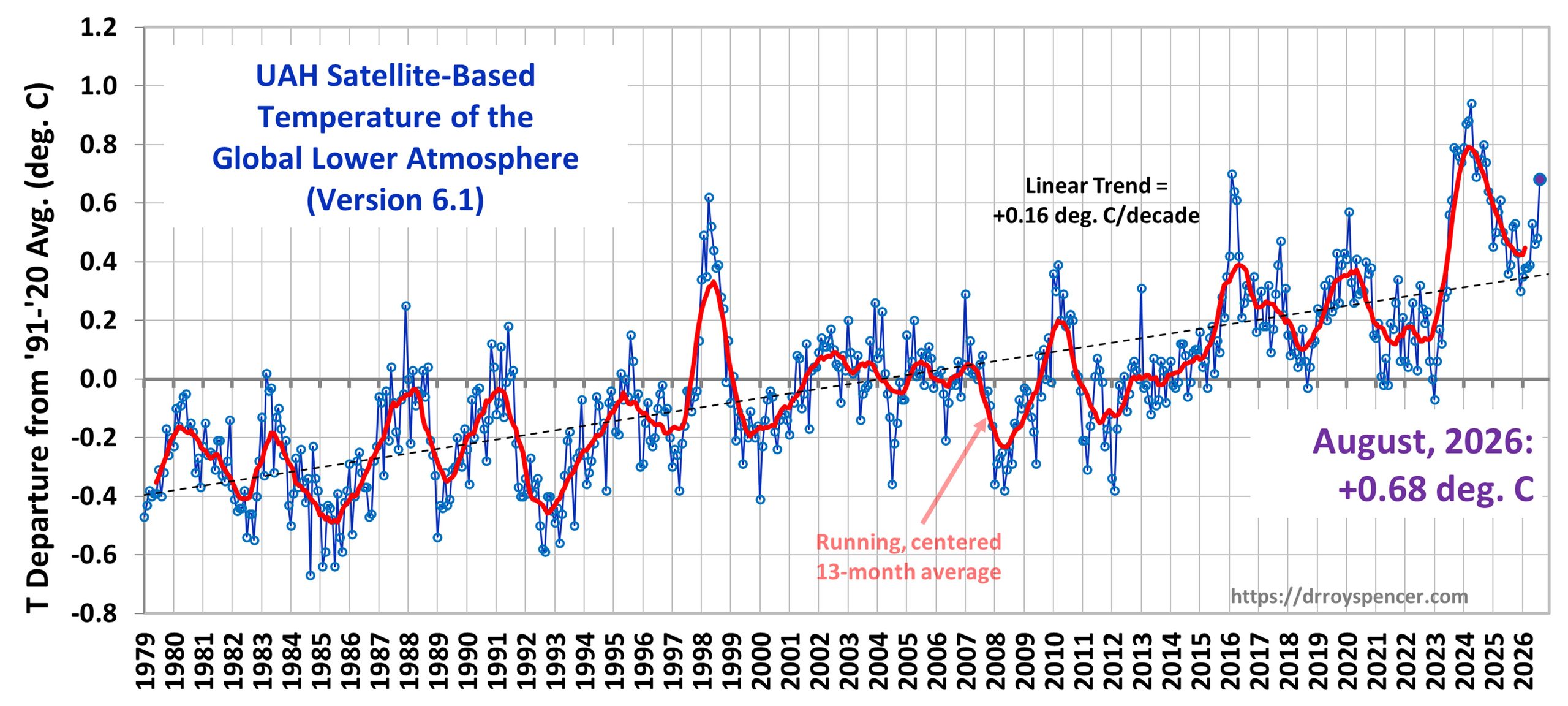
And yes, there’s a temperature spike. But there’s no plausible way to correlate that line, or any significant part of it, with atmospheric CO2. Which would lead anyone not in the climate cult to suspect other factors.
For instance Hunga-Tonga driving a spike then fading, followed by an extremely strong El Niño. And then you’d subtract that stuff and get a distinctly unscary line of gentle warming that has gone on with fluctuations since about 1750 and thus is plainly mostly natural and also, though not in consequence, mostly beneficial.
Still, must… have… storms. So the Sept. 8 Heatmap AM newsletter [the usual no-link complaint] declared breathlessly that:
“After decades without a major storm, Hawaii is set to be brushed by its second hurricane this season as Hurricane Lowell comes within 100 miles of the state’s western islands”.
Brushed, you say. As in missed by a hundred miles. It got better on Sept. 9, except it didn’t:
“Hurricane Lowell came within 40 miles of making landfall over Hawaii, knocking out power in much of Kaua’i • The Atlantic hurricane season, which hit its climatological peak this week, is now trending toward a record low amount of storm activity”.
Nooooo! Not record low. Didn’t someone say climate change was making hurricanes worse? Wasn’t it a standard gotcha claim short years ago? But fear not. They found some storms. On Sept. 10 they went:
“The Pacific just can’t catch a break this hurricane season as forecasters warn that a new tropical development called Invest 96E could form in the next two days off Baja California, right behind Hurricane Lowell”.
Sadly, it’s pretty hard to scare people with a tropical development. Unless it’s a resort on a previously unspoiled beach or island, we mean. But in any case the alarmists just can’t catch a break as the 2026 Pacific season, predicted to be a bit above average, has so far been a bit above average. As, we remind the statistically-challenged, about half of all seasons are. Oh, the ravages of climate change.
