
Few things could be uglier than alarmists backing and not filling on the Nepal-Tibet flood disaster even after the cause was determined not to be climate change. Like Unscientific American insisting on September 2 that “while it’s too early to say whether this event was caused by rising global temperatures, the trend is clear: Earth is getting warmer, and that will make disasters like this worse and more common. The rest of the world should be on notice.” Yeah well with them it’s never too early to jump to the same conclusion they always reach regardless of the evidence. Likewise National Geographic continues to maintain that “Although scientists are still determining precisely what happened” and “this specific catastrophe was unanticipated, this type of hazard – the rapid, violent collapse of a glacier – is becoming par for the course in a rapidly warming world.” And Climate Home News did a vulture dance on September 4, long after it had become clear that the initial “Gotcha” about glaciers had been uninformed and wrong: “Sadly, it was only going to be a matter of time before a climate-driven disaster would test the UN’s new fund for loss and damage. Soon after it started considering proposals, that came in the form of the glacier collapse that unleashed a massive flash flood in Nepal last week.” Conclusion first, evidence second, and we’ll ignore it if it contradicts our conclusion. Disgraceful.
Since they repeat themselves we must too. The admission that while they don’t know what happened or how they have reached a conclusion anyway is a red flag for dogmatism not principle. And to point to a rare event and call it common, even in the news of the future, borders on dishonesty. As when NG headlines that piece:
“Nepal’s Glaciers Will Flood Again. Can Scientists Predict the Next One? The Himalaya is one of many places around the world home to glaciers that are increasingly becoming unstable as the planet warms.”
Unstable? What does it mean and how do they know? It is true that glaciers have been melting for centuries as the planet warms, naturally, from the depths of the natural Little Ice Age that is not visible in Michael Mann’s notorious hockey stick. But as they shrink, surely the decreasing volume of ice spells a decreasing volume of meltwater. But more crucially, what actual data do they have on whatever they think “unstable” means in this context to show that it’s increasing?
They list a few recent ones. But they don’t ask what we know about past ones. (Or mention Roger Pielke Jr.’s point that both the local population and the tourist trade have increased dramatically in recent years, meaning anything that does happen will claim more victims.)
Instead they assert that there’s nothing to know:
“No single disaster can be solely attributed to higher atmospheric temperatures. But here, the high-altitude permafrost – ‘the cryospheric glue that’s held the snow/ice/rock together for millennia,’ says [“a National Geographic Explorer and glacier hazards expert at the University of Colorado, Boulder”, Alton] Byers - has likely been weakened by our warming world.”
Again you get this weird portrait of a world in stasis until around 1988, one utterly unsupported by the data.
OK, we have to show it again.
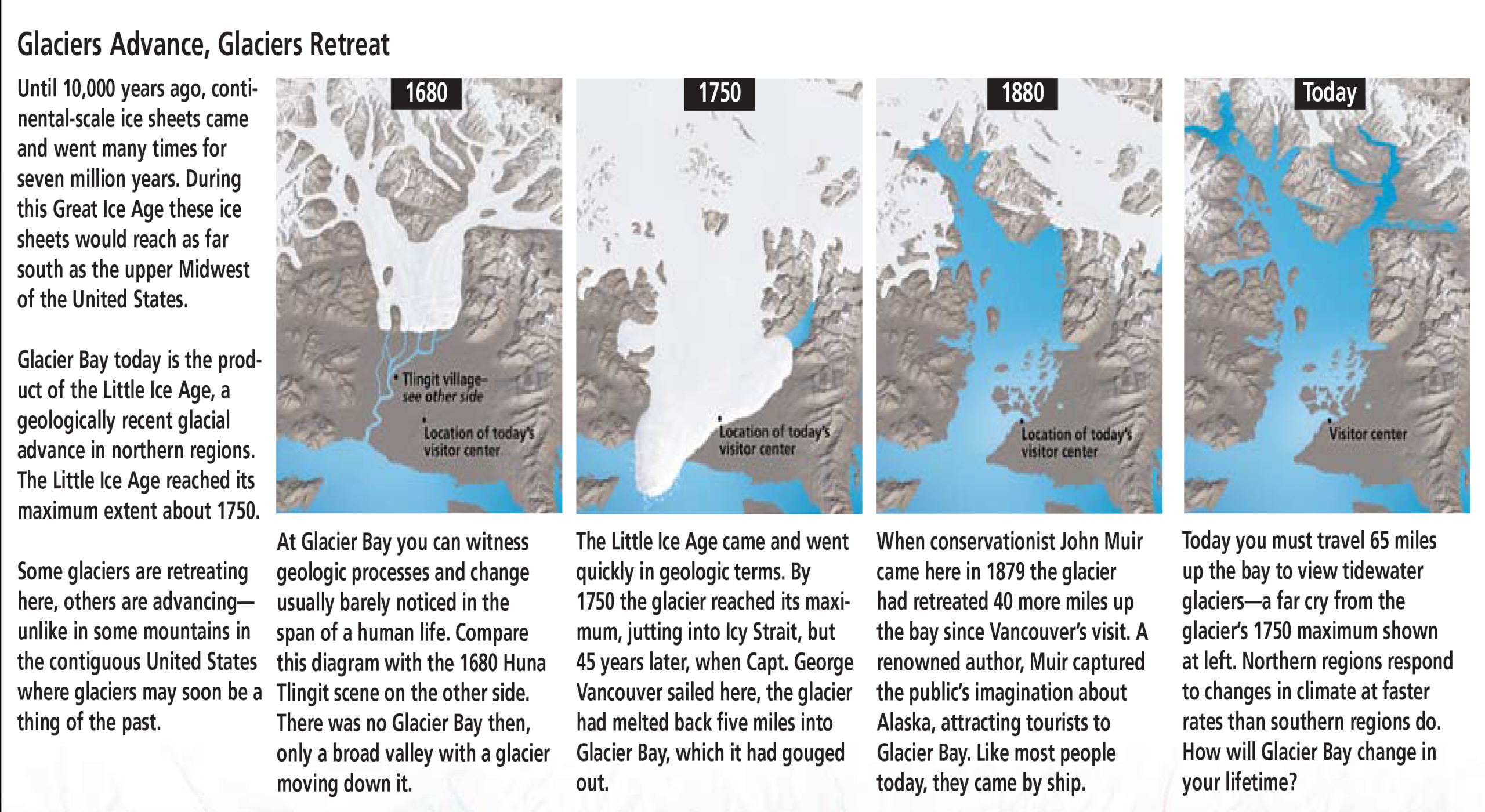
It’s from a brochure one of us was given in Alaska 13 years ago now, and it shows dramatic retreat of glaciers from their peak in… what’s this? Yes, 1750. With most melting before 1880. After having surged forward over the previous few centuries, in the process turning lush valleys into rocky fjords.
It would be very difficult to look at such maps, clearly showing a massive retreat of the glaciers prior to 1900, and claim that what happened after 1900 was the really dramatic bit. Though people do. But it would also be very difficult to look at evidence of similar phenomena around the world, from New Zealand to South America to yes Nepal, and claim that what happened after 2000 was unprecedented and that the entire previous melt did not create instability. But again people do. They call it “following the science”.
Bloomberg Weekend was even more ridiculous, brushing aside the ongoing uncertainties as to what even happened let alone why, including doing the settled-science-worse-than-expected and warming-twice-as-fast-as-everywhere-else two-step:
“The giant wave of rock, ice and debris that swept through 100 kilometers (62 miles) of Nepalese valleys last week is the deadliest illustration yet of how climate change is fueling mountain disasters of epic proportions. Scientists have long predicted quicker melting of snow and ice and accelerated thawing of permafrost in high mountain areas that are warming twice as fast as the rest of the planet. For years they have documented the results: more frequent rockfalls, avalanches, lake outbursts, flash floods and landslides. Even so, the sheer scale of the disaster in Nepal shocked experts.”
Further along they repeat that the experts who foresaw everything were shocked at what happened:
“The sheer scale of the Himalayan deluge shocked even climate scientists. They know it won’t be the last.
Um then why did it shock them? Well, see, Bloomberg maintains that this kind of disaster has become common while remaining rare:
“Events on the scale of last week’s disaster are likely to remain rare, but the underlying changes are accelerating.”
And Scientific Exaggeration swoops in yet again, with:
“How the super El Niño could turbocharge warming in the Himalayas/ After one of the worst natural disasters in the region’s history, attention is turning to the looming super El Niño”
Which is silly even as a description of activists, since they’ve been paying attention to the looming super El Niño for months, almost as if hoping it would cause photogenic disaster. And it gets sillier, as they say:
“Many questions remain about the role of climate change in this disaster. But as the first analyses begin, experts are also looking ahead to the potential effects of a looming super El Niño that could supercharge warming in the region.”
And what, pray, are these questions that remain? Nobody knows, least of all them, as the piece immediately continues:
“Rising global temperatures have made high-mountain areas across the globe more unstable – and the risks of cataclysmic events have increased. Now, in addition to decades of global warming, this year is expected to see one of the strongest El Niño events ever recorded. The climate event could have unpredictable effects on Nepal, Tibet and the Himalayas, experts say.”
Need we say again that this thing about “more unstable” is bunk, with no evidence offered and none sought? Or can we get right to ridiculing the experts who say for saying it might be unpredictable. What, unless it’s not?
The whole thing is about having your uncertainty and dogmatizing it too:
“Scientists don’t have enough information to say whether the brewing El Niño had any part in the Nepal-Tibet floods. What they do know is that this August was ‘anomalously warm,’ which ‘could have contributed to enhanced snow and ice melt and potentially slope instability,’ [“Mingfang Ting, a professor at the Columbia University Climate School”] says. But, she adds, ‘whether the August warming itself is linked to El Niño is much less certain.’ The region has seen above-normal warming for several years, which points more to the role of human-driven climate change, [associate professor of geoscience at the University of Arizona Kaustubh] Thirumalai says. But next summer, once the looming El Niño has set in, researchers may want to ‘keep an eye out’ for even greater warming in the region, he adds.”
It really would be difficult to write a satirical piece that was more riddled with climate clichés, including in our view Columbia having a “Climate School” dedicated to carefully not examining one side of the issue. But especially the thing about admitting they were wrong to swoop in and blame this deadly tragedy on climate change, and then blaming it on climate change anyway.
To its credit, NG admits that monitoring unstable geological phenomena might be a good idea. Still, we are all going to die, maybe:
“But will they be enough to help millions survive our planet’s increasingly warm future?”
Again the obvious answer is yes because the glaciers will melt away and then they will stop melting because they have disappeared. Possibly not the ideal kind of stability though, again, no one has ever managed to explain why a cold world with a lot of land underneath ice is better than a warm one with plants growing. But also obviously not what they say.
Instead Climate Home News does a “your money or your life” thing:
“if the world is to have any chance of avoiding an exponential surge in deadly disasters linked to climate change, politicians can no longer deprioritise measures to adapt to the effects of higher global temperatures. Pay now or pay more later. A new report from the UN Environment Programme on Wednesday was unequivocal that extreme weather, sea level rise and other consequences will get worse as global warming exceeds the Paris Agreement limit of 1.5C in the coming years.”
Yeah. But it’s just a prediction based on models we know exaggerate. They may be unequivocal but it doesn’t mean they’re irrefutable.


My guess is that there were few times on that mountain at 18,000 ft when the surface got above freezing let alone the deep rock under the glacier so even if it has warmed in that area temperature is not likely a factor in the failure of the substrata. It is also worth noting that the glacier most likely was nonexistent 8000 years ago just like the glaciers in Glacier National Park.
The Glacier Bay data actually show that the glacier retreat has been slowing from 1880 to today, compared to pre 1880 retreat. As for El Nino, we currently aren’t yet in one and the RONI isn’t particularly strong yet, so don’t blame anything so far this year on an El Nino.
A factor that seemingly is not taken into consideration is plate tectonics as the Indian plate is still moving into the Asian plate and put immense pressure on the Himalayan mountains and thus could more than probable be the engine driving the instability in rather steep rock formations with gravitational forces doing what it always do.
The climate porn crowd absolutely love these disasters,even though they occur naturally.And that crew don't give a crap about lost or shattered lives in Nepal or elsewhere.And remember those signs at Glacier National Park saying that the glaciers would be gone by 2020?Signs were quietly taken down.Glaciers are still there.