
Tony Heller notes on X that “Over the past twelve months the surface of the Greenland Ice Sheet has gained more than 500 billion tons of new ice and snow.” By this time of year the average ice formation rate is typically about 375 billion tons, based on data from 1981 to 2020. This new ice replaces at least some of the ice lost at the margins to melting and calving glaciers. So this year the rate of new ice formation is about 33 percent higher than average. And it’s not a one-off: in six of the last nine years ice formation was above the long-term average rate. If we were given to alarmism we’d call it the “new normal” and start worrying about a coming ice age.
Or, more accurately, a coming glaciation cycle within the current ice age which has been ongoing for about 2.58 million years or, if you count persistent ice at just one pole, 34 million. But we’re not alarmists, just observers of data on our complicated and wonderful climate system. Such as the data Heller pointed to, which charts in this manner:
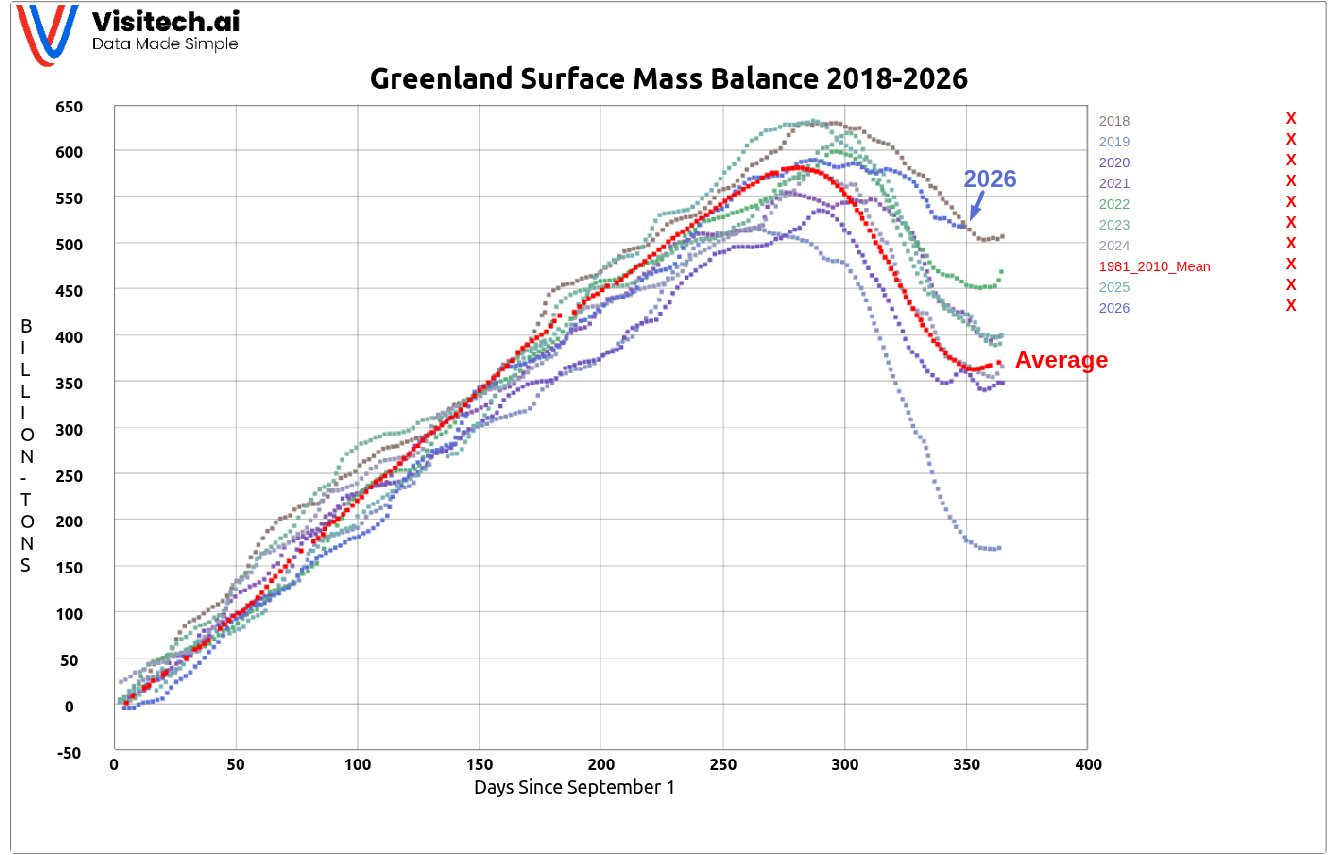
It is drawn from the Danish government’s Polar Portal website. 2026 ice formation on Greenland is shaping up to be the highest in the past decade. Which, again, doesn’t mean it’s a trend or a new normal. Especially when a phenomenon is highly variable, whether natural or not, you need a long dataset to determine (a) what is normal and (b) whether it has changed.
A point we also need to make whenever someone points to the anomalous forest fire activity in Canada this year and in 2023, declares it to be the new normal and a harbinger of doom.

