
While we were on holiday the drumbeat of wildfire stories and “Gotcha!” commentaries continued. For instance on August 10 Reuters “The Week Ahead”, another of those newsletters incomprehensibly not available online, going “Hard reality of climate change hits Europe” and shrilling “record heat and droughts this summer – which scientists say are exacerbated by global warming – have wreaked havoc in power production, shipping and public health systems, while the wildfire season is on track to be Europe’s biggest ever.” As a result of which you’d have to be one of those weirdos who pays attention to data to realize that, as Bjorn Lomborg complained, “By August 5, North America has burned less than in any year 2012-25/ Every continent below average, w/Africa and South America also record low.” He then points out that the selective media coverage “leaves you badly informed”. Indeed. And them too, since as usual the problem isn’t deliberate deceit but chronic cluelessness.
Part of the trick is guilt by association. For instance “Wildfires continue to rage as Europe swelters under extreme heat”. And for good measure “Europe is the world’s fastest-warming continent, with temperatures rising at around twice the global average.” It implies both a connection and a massive phenomenon. So you have to be paying attention to realize they’re talking about small fires in Serbia. For instance:
“Local authorities said the flames had scorched at least 700 hectares of land in the Deliblato Sands special natural reserve, located roughly 50 kilometres east of Belgrade.”
We do not wish special nature reserves to be scorched, of course. But the headline strongly implies that Europe is on fire en masse and it just isn’t. And the fact that there are small scattered fires is not proof of a massive rise in temperature or of a link between any change in average temperature and a change in the frequency or severity of fires.
Or suppose you read a news story of this sort:
“Hundreds of wildfires are burning across North America, putting communities, buildings, and firefighters at risk. With blazes in Washington state, Oregon, Idaho, Montana, California, Utah, and in Canada, especially in British Columbia, Ontario, and the Northwest Territories, there have been plenty of headlines about the devastation. Last month, smoke from Canadian boreal forest fires poured into the United States, triggering air quality alerts for more than 120 million Americans. Influencers and media outlets shared dramatic footage and discussed the air quality in cities like New York and Chicago as smog blanketed their regions.”
It doesn’t actually say it’s unusual. But again you’d have to be very well-informed to read it and mentally add “just like usual” and then wonder why it’s a news story that the same old stuff is happening.
But wait. It does say it. It cites “Lori Daniels, a professor of forest and conservation sciences at the University of British Columbia” who:
“said both countries [Canada and the US] need to move away from the postwar mindset of fire suppression and commercial-timber forestry where possible, and toward management that reflects today’s hotter, drier conditions.”
But wait again. You also get decolonization and the wisdom of the elders, very much the woke du jour in Canada nowadays:
“‘In Canada, temperatures have increased by more than one degree Celsius, and in the north, where those fires are having huge consequences, many of those areas have warmed more than two degrees Celsius,’ she said. Those areas have also experienced multi-year droughts, while forests grew denser after Indigenous burning practices were banned and suppression became the dominant policy, Daniels noted. Even doing everything right won’t stop fires, she explained. ‘Doing those improvements isn’t going to stop wildfires,’ she said. ‘We are going to be living with more and more fire on our landscape.’”
Except when we’re not. There is less fire on our landscape than there was a century ago, not more, and the number of fires is not trending upward. She, and they, have said the thing that is not. As have others; we routinely encounter “reporting” like “Premier David Eby has declared a provincewide state of emergency and B.C.’s wildfire service warns the conditions are explosive and unlike anything they’ve ever seen before.” No they’re not. They’re not even as bad as 2023. And as Wikipedia observes, before kowtowing to the prevailing dogma:
“British Columbia is the westernmost province in Canada, and is prone to wildfires. Wildfires are extremely common during summer...”
Yup. And they burn like wildfire. We know alarmists are flexible as to when the effects of man-made climate change hit, are hitting and will hit, but the BC provincial authorities in giving summaries of recent wildfire seasons also include 2003 because:
“The 2003 fire season was one of the most catastrophic in British Columbia’s recorded history. Due to an extended drought in the southern half of the province, forest firefighters faced conditions never seen before in Canada.”
As so often, apparently.
The situation is scandalous. In a typical example, Heatmap blares “The wildfires in Spokane, Washington, have now incinerated 850 structures, most of which were homes”, with the clear but incorrect implication that it’s proof that fire is out of control and it’s our fault. And then they write, even more culpably:
“The U.S. is facing its most brutal wildfire season in years, with blazes ‘scorching millions of acres.’ That’s according to a new analysis by Bloomberg, which found that the 17 fires raging across Washington State have now displaced more than 60,000 people — roughly 10% of the Spokane area’s population. Across the U.S., there are at least 44,722 fires raging across about 5.2 million acres, data from the National Interagency Fire Center shows.”
But as of the time of this writing the cumulative area burned by wildfire in the US is vying for the lowest level at this point in the summer of any year since 2012. Meanwhile the Bloomberg item in question shrieks “Global Wildfire Surge Hits US, Propelled by Rising Temperatures” but offers no data. So let us show you the global data:
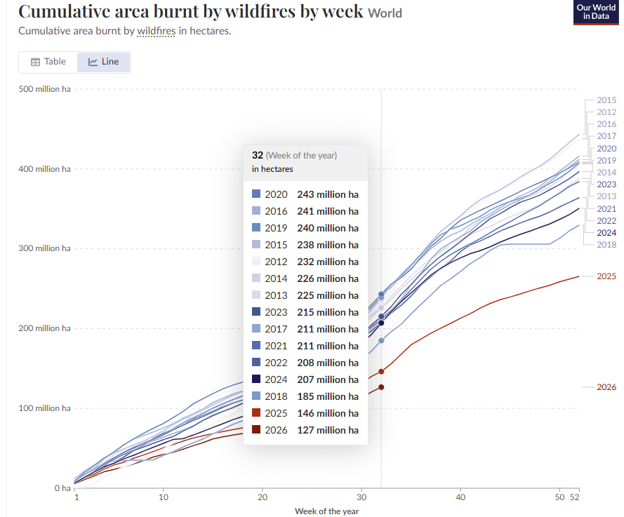
Global wildfire has surged to… the lowest level at this time of the year since 2012. Bloomberg adds:
“With fires now happening everywhere all at once, nations will be constrained in their ability to come to each other’s aid by dispatching firefighters and equipment. Communities that didn’t think they needed evacuation plans or fire mitigation measures will need to reevaluate.”
It’s not just the press, of course. (Though it is them, with the herd of independent minds showing stuff burning and not giving context.) The usual suspects are blowing smoke too. For instance we got a press release, of which they don’t seem to have been sufficiently proud to post anywhere, quoting the usual Simon Stiell, UN Climate Change Executive Secretary, “on an embargoed World Weather Attribution analysis of the impact climate change has had on recent wildfires in Canada, including in Ontario and the Northwest Territories” that:
“The science is in: these fires have been made twice as likely by global heating. They are tearing through homes, communities, businesses, and the forests that economies depend on. The science backs up what people on the front lines already know: humanity’s addiction to burning massive amounts of coal, oil and gas is heating our planet, turning more of Canada’s vast forests into tinderboxes, and spreading dangerous smoke far beyond the flames.”
So if they attribute the hallucinated increase in wildfires to fossil fuel use, will they admit that the actual decrease must also be? Heck no. We also got a newsletter from the “Council of Canadian Innovators” that started:
“Dear CEOs, This summer, wildfires are disrupting communities across Canada, Spain has declared a national climate emergency and tens of thousands of people have been evacuated in France. August may be the traditional month for switching off, but the heat has other plans.”
From which you might easily conclude that there was some unusual problem with wildfires in Canada, or indeed with heat. But there is not.
It gets worse the further down you go. But not by as much as such a descent should imply. Someone hiding behind the revealing moniker “Unite Behind the Science” posted back to Lomborg:
“See how often Bjorn posts? These heatwaves are a living nightmare for him and his fossil fuel-funded narrative. This is the behaviour of a man with a very bad conscious.”
And while some might hesitate to receive lectures on nollij from someone who doesn’t know the word “conscience”, let alone have any data to offer, what’s more revealing is the immediate resort to (a) conspiracy theory (b) character assassination instead of data presentation, (c) using first names of people to whom you have not been introduced to show disrespect and (d) this notion that enforced consensus means following the science rather than the herd.
Now all this yelling would still be a problem if we were facing rising amounts of wildfire, 2026 was yet another record-breaking season and so forth. But as Lomborg noted, it’s not. This yelling is going on when every single continent is experiencing lower than average wildfire. Which inclines one to doubt the other stuff they shout too.


According to UK media Britain and Europe are on fire and they're pointing an accusing digit at climate change.
Not mentioned on mainstream media but some 2 weeks ago there were nearly 600 individuals arrested in Europe for deliberate arson. Only 4 arrests in the UK so far. Apparently there's a TikTok thing doing the rounds suggesting youngsters start wildfires and post the videos of their "achievements".
The fact that the media is making hysterical claims about anything remotely associated with climate change suggests that most people are losing interest in the subject, and lost of interest is the real existential threat to the media.
Always a fascinating coverage of the omnicause, John. I look forward to each Wednesday's Newsletter.
The data presented about cumulative area burnt world-wide leaves me wondering how much of it is due to fire suppression activities. I suspect that these efforts are more pronounced in wealthy nations of the Northern hemisphere. Many of these areas must be in areas previously uninhabited. Still, it is a relief to see those numbers . Our World in Data shows that temperate deforestation peaked in the first half of the 20th Century (115 million hectares net loss per decade). Losses have been declining since the early 1990s. In the last decade, net loss was 47 million hectares. The data do not show the cause of net loss, but we can be sure that fires are one of them. Brazil (4-5x) and Russia (2-3x) show much more area burnt by wildfires than Canada and the USA, (2012-2025)
We live in British Columbia and in 2018 we took a trip up to Alaska in mid August. It was very rainy in Alaska that year but we lucked out and had several sunny days as we visited Denali National Park. When we returned home to Chilliwack, it was unbelievablely smoky, we couldn’t see across the valley as there were several fires close to Chilliwack that summer. Of course, all the experts were blaming the fires on climate change. We haven’t had similar smoky conditions since then although we have had some smoke this summer but not nearly as bad as 2018. Meanwhile, in Alaska, they sent the fire crews home early in 2018 because there were no forest fires. So, my conclusion is that the climate changed in B.C. but didn’t change in Alaska.
Ironic that Jay Inslee,former Democrat governor of Washington State claimed that wildfires in the Spokane area were caused by man-made climate change.Then the very next day they arrested a man there for arson,for starting those very fires.
"Climate Change" causes bushfires to peak on weekdays between 3 and 6 pm in Australia, they say.
Australia knows a thing or two about bushfires since Captain Cook circumnavigated the continent and located aboriginals by the smoke from "cultural burning".
The Australian Bureau of Criminology has published research based on extensive study of fires and their origins with results finding a much more complex situation than the alarmist media projects.
"Over 90 percent are the result of people's actions, and more often than not the result of deliberate ignitions; incendiary (maliciously lit fires) and suspicious fires account for one-half of known fire causes in Australia, and are the largest single cause of vegetation fires".
https://www.aic.gov.au/publications/tandi/tandi350
Detailed analysis also points to where effort to prevent fires can be efficiently directed.
"The role of children in lighting fires is shown in the higher than predicted numbers of both deliberate and accidental fires between 3 pm and 6 pm, Monday to Friday."
I have yet to see any discussion about ignition causes and practical countermeasures surface in our media, anything other than "Global Warming" seems taboo as is any incentive to build in fire prone areas with well proven less combustible techniques. Tar paper shingles and plastic siding being stapled on the Fort Mcmurray rebuilding was not encouraging.
Any evidence of serious study in Canada would be appreciated.
There is a gross conflict of interest involved in CAGW as academia depends on the hysteria for funding and politicians need it for empowerment over the masses, along with the codependence of the media and political class. I couldn't stand being even a non practicing retired professional forester in BC (and resigned) as they were just another captured institution now essentially an appendage of the state that grants their monopoly right to practice where they exchanged science in favor of such PC tropes as CAGW and "Indigenous Knowledge" (racism masquerading as mysticism) and implementers of DRIPA. BC now has political appointees on the boards of all professional governing bodies not unlike the soviet military with political officers imbedded in the officer corps.
CON deniers still confuse "caused by" with "made worse or more likely by". Are they taht stupid, or is it deliberate deception, to which they have also succumbed?
Lots of deniers still yell "But but but arson!!!", while simultaneously confusing that deliberate act with negligence.
All while ignoring the fact that fires are so much easier to light, burn hotter, and spread so much more quickly than ten years ago. It's odd they ignore that basic fact. Perhaps it doesn't suit their anti-science agenda.
It's all a load of "flummery".