
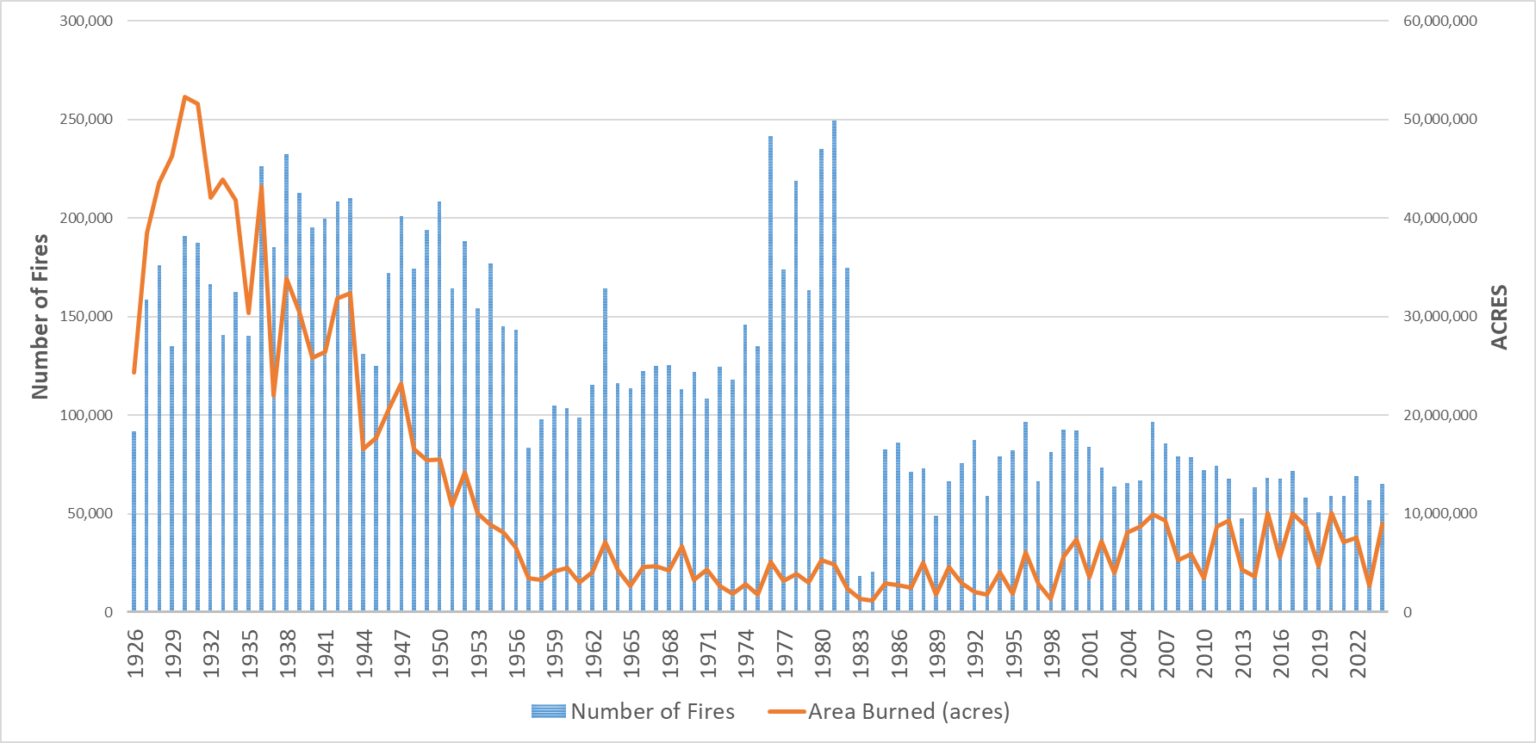
Forest fires have been a hot topic the last few years since there were some bad ones in the Amazon, LA, BC, eastern Canada and, once again, eastern Canada, and a lot of people have said some very ignorant things about their becoming more common and indeed the “new normal”. Global data say otherwise; they are not becoming more frequent, especially not by comparison with the early 20th century and certainly not with earlier centuries. Even though bad forest management practices have contributed to the severity of individual fires and satellite coverage was and is making it easier to detect them this is not the same as them becoming more common. It’s time to learn to see the forest for the burning trees.
The climate ghouls certainly leapt on the flames consuming Los Angeles in very early 2025, which turned out to have been the product of human error both long-term and catastrophically in the moment, in an area that prior to European settlement was such a constant blaze that the first European to see San Pedro Bay called it the “Bay of Smokes” and remains fire-prone. And by the way California law lets insurance companies raise rates if they say it’s due to climate change, so they do. But it’s not.
It’s astounding how ahistorical this kind of coverage is. In April Bloomberg Green noted a dramatic drop in deforestation that was itself just a blip. And really, what can one do with a headline like “How Global Deforestation Declined 36% in 2025”? Or an article that being climate-related is all bad news all the time:
“But it was still 46% higher than a decade earlier, and last year saw a relative lull in wildfires after an exceptionally bad fire year in 2024. Blazes are increasing in the tropics due to warmer temperatures and more severe droughts.”
No they aren’t. Not there, not anywhere. To the extent that anybody even knows, though if you think we have accurate wildfire records for central Africa in the 18th century you are demented.
The US, which as usual has the best historical records, has seen a dramatic decrease in fires in the last century. Still, all fire all the time:
“Outside the tropics, the climate signal was starker. Wildfires burned 5.3 million hectares in Canada, making 2025 the country’s second-worst fire year on record. In France, fire-driven tree-cover loss was the most severe on record, seven times higher than in the previous year.”
Again, no. As we pointed out last September, the records in question in Europe, a place including France, only go back 20 years. It really is insolent to treat the last two decades as all of time, even if it’s done in insolent ignorance.
Which it is; we had to ferret it out for that blog item because the journalist certainly hadn’t bothered to look it up. And since their story gets into the climate-zealot news doom archive, the claim gets repeated again and again and this crucial disclaimer is ignored. As we sneered at the time “if you believe forest fires didn’t rage unchecked across large parts of Europe in the 10th or 17th century, when there were neither fire departments nor ministries of forestry, you … uh… well, you could get a job as a reporter, we suppose.”
Thus the Guardian speaks of “one of Spain’s deadliest wildfires” as if we knew how many people wildfires there had killed in the 16th century, or even the 19th. And cue the usual chorus:
“Extreme heat has fuelled devastating wildfires across southern Europe in recent years, the latest in a series of disasters exacerbated by climate breakdown amid a continental rollback of green policies.”
As if, again, they had the slightest idea of, or interest in, the number or severity of wildfires across Southern Europe in the Renaissance, the Dark Ages, or that of Augustus, during various kinds of climate breakdown like the end of the Roman Warm Period though not of a “continental rollback of green policies” that also isn’t happening. (As we’ve commented elsewhere, it seems that only urban fires got recorded in days of yore, though not consistently, partly because literate people were concentrated in cities and partly because nasty forest fires were totally normal and people weren’t neurotic dolts who reacted to them with ignorant cries of “unprecedented” every time a bunch of wood ignited.)
As for Canada, yes, we had a lot of fires in 2025, and in 2023. Whereas in 2020 we had the fewest fires and the smallest area burned, so evidently climate change only began in 2021. In case they hadn’t noticed, fires are loosely cyclical, because having years where not much burns piles up fuel that makes fires more likely to be bad when they get started. And then bad fires use up the fuel making fires less likely as time goes by, and also less likely to be bad. And so forth.
Thus one year is not a “signal”. It’s noise. And what’s worse is that if hurricanes are up and wildfires are down, such people see a “signal” that hurricanes are up because of “climate change” and will stay up, whereas wildfires are down because never mind. Or they say they’re up even if they’re down. (Thus Canada’s Prime Minister just posted that 2026 is “one of the most intense wildfire seasons in Canadian history” which simply isn’t true. But the Canadian Press and others passed it on as truth.)
Then if the next year hurricanes are down and wildfires are up, they go “Gotcha!” again. And if both are down, they say the new normal is still that they’re up. As indeed the Canadian government did this spring, bloviating that “Wildfire seasons are becoming longer and more complex. Canada’s new government is taking action to strengthen our ability to respond by moving from a culture of recovery to one of resilience”. The usual bit where you cannot believe what they say if you’re lucky enough to understand it, since Canada does not have a “new government”, the same party having held the Prime Ministership for 11 years and the current occupant for 14 months at that point.
Undeterred, another ministerial cipher was quoted that:
“Nationwide, Canadians are experiencing the growing impacts of wildfires. From poor air quality to evacuations, their effect on our summers is now undeniable. Climate change is resulting in longer and drier summers, which contributes to increased wildfire risk.”
As the season progressed, they struggled to contain their disappointment, conceding in early June that “The 2026 wildfire season began more slowly than in 2023 or 2025 which were the worst and second worst wildfire seasons in Canadian history” before chortling that:
“looking forward into the summer, the current forecast indicates that wildfire activity will increase in the months ahead. The federal government continues to monitor conditions closely and stands ready to assist provinces, territories and Indigenous communities if needed.”
And a National Post profile of the only Liberal MP from Alberta, Eleanor Olszewski, included:
“Now serving as federal minister for emergency management, the MP for Edmonton Centre is bracing for another wildfire season, one that she comments has so far been quiet, but expects to see light up with alerts come July.”
Burn, baby burn. C’mon. You can do it.
Alas, as even she and her colleagues admitted earlier this month, “Current 2026 seasonal wildfire activity remains below the five-year average” though they added as if it were some stunning new discovery that “fire danger continues to rise over the summer.” (And that there was a lot of rain in some places. Canada is big.) And as Wikipedia summarized this strange way of dealing with actual facts:
“The 2026 Canadian wildfire season began slowly but at high risk, with over 108 active wildfires across the country in mid-May, primarily in Alberta, British Columbia and Saskatchewan…. Wildfires were reported in at least eight provinces and two territories. The start to the season was well below average, though government officials warn that as the summer progresses there’s a risk things could get much worse and it could be significant. While the wildfire risk is unlikely to result in a record-breaking year like 2023 or 2025, the federal government is forecasting above average conditions as the season progresses, with British Columbia, Alberta and the Northwest Territories facing the highest wildfire risk.”
Risk. Could. Could. Unless it doesn’t. As a matter of fact later in July we did get above the 10-year average so now they are happy. But hot tip: Canada has over 300 billion trees, not counting the 2 billion the government tried in vain to plant. Wildfires happen in such circumstances. And always have. Not the new normal. The old normal. Like hot summers in Spain, one is tempted to add.
Followed by the US also has a lot of trees. And Heatmap was celebrating the disaster with “It’s already been an historic year for wildfires” and you will choke because:
“The 2026 wildfire season is already one for the books. Fires had burned 2.4 million acres in the U.S. as of Monday, nearly double the 10-year average for the start of June. And the months ahead don’t look good – about 17% of the country is already in extreme drought, and an all-but-certain El Niño will bring warmer, drier conditions to the already volatile Northwest and suppress or delay monsoon precipitation elsewhere.”
You get the idea. It’s “one for the books” because it’s above “the 10-year average for the start of June” or whatever makes it sound worse. Then they treat a guess as established fact (“the months ahead don’t look good”) instead of telling you how far back this fabled 10-year average goes. Which sure as heck isn’t pre-1960.
To our pleasant surprise, the Heatmap item did actually contain a hyperlink on that “average” business and if you persevere you eventually discover it’s the last 10 years. Not a typical 10 years. And you simply cannot understand climate, by definition the state of weather somewhere over at least three decades, with such short time horizons. But you can do climate journalism.
Including a Canadian Press story seized upon by MSN, Yahoo!news and The Weather Network about how in Canada:
“Wildfires are no longer just a summer problem. The Weather Network’s Mia Gordon explains how climate change, drought, and warmer winters are extending the fire season into a year-round threat, forcing fire services and residents in British Columbia to adapt.”
And again, if you were looking for evidence that fires did not use to burn in Canada in winter you’d be in the wrong place. Though it may well be that governments did not try to fight them in mid-winter decades ago. But if you were looking for hyperventilation, you’re right at home.
As usual.


"Climate change is resulting in longer and drier summers"
Umm - has anyone checked the weather this summer in Eastern Ontario? For those who live in that fabulous far-off land of climate change, our weather has been rain, rain and more rain.
Lesson from Goebbels: The lie must be repeated often.
By definition there's about a 50% chance of any year being above average in any metric over any measurement period if the thing you're measuring is random enough, such as the weather.
Unfortunately there is more than one liberal mp in Alberta, my calgary MP Corey Hogan. First time in my life with a liberal mp and he’s every bit as dumb as you’d suspect,
Funny that when wildfires were generally worse in the past,media coverage was relatively light.And then they didn't blame it on climate change either.Now almost every story about wildfires contains some reference to the usual climate scare narrative.