
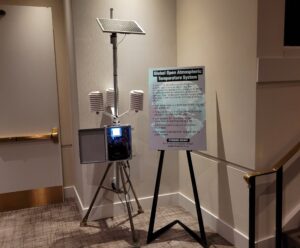
Anthony Watts of Watts Up With That fame gave a talk at last week’s Heartland Institute International Conference on Climate Change on his discovery and ongoing investigation of the increasingly unreliable US temperature monitoring network. Incredibly, they’re more likely to close well-sited than poorly-sited stations, resist fixing problems with station siting when alerted to them, and use and manipulate data from closed stations. As a result, he estimates that roughly 96% of their measurement sites are not fit for purpose, which seems like a lot. Moreover, a classic piece of American voluntarism, he developed his own portable GOATS (Global Open Atmospheric Temperature System) station to check various official U.S. Historical Climatology Network (USHCN) stations. And the result is more or less what you’d expect if you’re a regular CDN reader: the US record is systematically, even wilfully, distorted by the Urban Heat Island effect. Oh, and Watts will sell you one of his devices essentially at cost… but only if you pledge to site it properly. Unlike the US government which, strangely, seems not to care whether its facts on climate are any good.
Speaking of the Heartland Conference, another presenter on the same panel with Watts, David Legates, made a detailed and convincing case that supposed increases in extreme precipitation events in the US are entirely a measurement artefact. There’s a discontinuity in the data right when there was a systematic change in measurement techniques.
In a classic case of statistical malpractice, alarmists including those embedded in key government institutions show a long-term curve that actually disappears if you divide the data set into the less satisfactory methods used before 1990 and those used afterward. Doing it properly, Legates showed, you get a flatline up to 1990 and a statistically insignificant decline after, with the step up at that point just because the better collection-measurement system was better, and thus captured more of the precipitation that actually fell. But what kind of discussion can result when the people loudest about following the science are not interested in the soundness of the basic data?
The same is of course true of other governments including the Canadian. There are serious reasons to doubt that its data is being properly collected either. But even given that problem, the data it has and that you can access at yourenvironment.ca does not sustain the claims it repeatedly makes. And it’s one thing to argue that trends do not mean what some say they mean and quite another to wonder whether the measurements are any good at all.
As Watts demonstrated, even changing the kind of paint used on the boxes within which thermometers sit, to protect them from the obvious distortion of being in direct sunlight, can change the amount of heat the boxes absorb from sunlight, thus creating an indirect but significant distortion. Moreover, and it’s another point that is statistically basic but is ignored by the zealots in government as well as without, the kinds of distortions that creep in through careless data gathering, culpable or otherwise, often approximate or even exceed the supposed change presented as authoritatively established to a decimal place or more.
There is a certain human tendency to crave certainty, and the scientific method over the last 500 years has achieved many remarkable feats based on measurement and calculation that were, indeed, very precise. But it has led to an unfortunate habit of claiming, and believing, that many things have been measured far more exactly, and carefully, than they actually were. So any effort to debate climate science rationally, assuming it is indeed the goal, requires a willingness to talk openly, and accurately, about the quality of the underlying data.




Anthony's investigation of the data errors produced by simply changing the specified whitewash of the Stevenson Screen (invented by Robert Lewis Stevenson's engineer (naturally!) father, to acrylic, lit my curiosity about the disastrous predicted "global warming". The remembered comment of an acquaintance who rode motorbikes in 1960s helmet less Britain, that he could sense the heat of approaching towns on his face when riding at night, made the initial claims that the "urban heat island" was a denier myth, confirmed my suspicions that data butchers may have had thumbs on the scale.