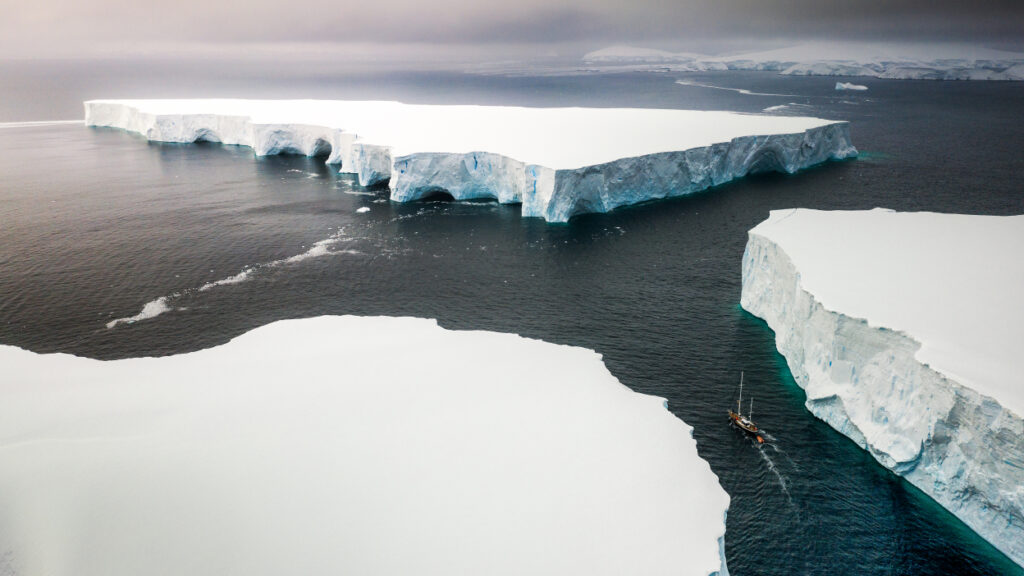
- Our climate-news blue bin bulges with items on the imminent collapse of the Thwaites “Doomsday” glacier, along with the AMOC. Like that one where the Daily Mail bellows “Is Antarctica’s Doomsday Glacier about to COLLAPSE? Shocking study predicts Thwaites could shed 200 gigatonnes of ice per year by 2067 – with devastating consequences”. Or not, because as Anthony Watts retorts “The Thwaites Glacier is estimated to contain roughly 600,000 gigatons of ice. Even 200 gigatons represents a tiny fraction of the total mass – just 0.033 percent.” So a century of loss at that pace would reduce it by 3%. Moreover, as Watts adds, the overall picture in Antarctica is complex, “with much of the continent experiencing net ice gain.” Media viewership, alas, is not experiencing net gain.
- We’re going to need a bigger blue bin. The Atlantic back in January wrote “The ‘Doomsday Glacier’ Could Flood the Earth. Can a 50-Mile Wall Stop It?” Uh, no, not if it’s really happening. They also wrote “Scientists have long opposed polar geoengineering. Some now believe it will be necessary.” But it won’t be possible. The Earth is big. Very big. We can’t make glaciers come, or go. Oh, and that article eventually describes efforts to put fiber-optic cables deep into the glacier because “The data the sensors gather over the next two years will fill gaps in basic scientific knowledge about Thwaites.” Gaps in basic scientific knowledge? And here you all sounded so certain.
- Um didn’t you say it was “clean” energy? Inside Climate News reports that “The U.S. Forest Service on March 5 announced it plans to soon approve the nation’s first critical minerals mine, South32’s Hermosa project, when it released the final environmental impact statement, which was permitted under a streamlined process. The federal government called it ‘a strategic investment in America’s energy future’ that ‘directly supports U.S. energy and security needs.’” OK. Energy security and renewables. Win-win, right? Not in the wacky world of climate alarmism. Instead, “in Patagonia, Arizona, residents and environmentalists are preparing for the impacts the project will bring to a world-renowned biodiversity hotspot… Since its inception, the project has drawn pushback from locals and environmentalists.” You just can’t win with these people.
- Apparently it’s Evans v Pritchard or something. We don’t mind people changing their minds but it should be the whole mind, not a patchwork of incoherent positions. We previously criticized columnist Ambrose Evans-Pritchard for losing his mind over a supposed 0.1˚C temperature rise “as the US keeps drilling”. Which was part of his long-standing objection to oil and gas. And suddenly, Paul Homewood notes indignantly, he now favours Britain “extracting as much oil and gas as the free market will deliver from the remaining – highly depleted – hydrocarbon fields.” And for good measure denounces how “Most debate about energy in Britain degenerates instantly into a culture war between conflicting certainties, compounded by the national pathology of clutching at straws.” As his own certainties crumble and he clutches at straws.
- From the “you couldn’t possibly know such a thing” file, we’re told by Newsweek, amplified by MSN, that “Days are getting longer as a result of climate change, as warmer temperatures lead to a slowing of Earth’s rotation at a rate scientists say has not been seen for at least 3.6 million years.” Uh, except when Superman did it in that 1978 movie. Which you may object is mere science fiction. But of course so is this story. The authors looked at layers of fossilized single-celled marine organisms whose gentle whispers allowed them to “infer historical sea-level fluctuations and calculate how those shifts would have affected Earth’s rotation.” Infer. Calculate. Assuming their model is right. And then “The researchers then applied a type of deep learning algorithm to the findings.” Deep no less. And hey presto: “today’s increase in day length is exceptional. Only one period, around two million years ago, showed a rate of change that came close to present-day levels, and even that episode was slightly slower than what has been observed between 2000 and 2020.” Yes, they are comparing sparse proxy records averaged over millions of years to data from the past 20 years. It’s not measurement. It’s just that if some fossils let you say exactly what the oceans were doing, which they don’t, and if your model is right, then what’s happening now isn’t what was happening then except when it was, sort of. But none of it proves the model is right.
- So close, and yet… Bloomberg Green notes that New York governor Kathy Hochul is trying to back away fast from the green energy wall. But it totally misses why: “On Friday, she [Hochul] proposed watering down the law requiring the state to slash emissions 40% by 2030. It’s part of an ongoing saga around the Climate Leadership and Community Protection Act, from lawmakers failing to pass a regulatory framework to raise revenue for implementation to environmentalists suing Hochul for slow walking measures to cut emissions.” Well, that and soaring costs and plunging reliability because the state went bananas on alternative energy. And the piece does admit that “At the center of the debate is how to deal with the affordability crisis.” But as for what’s causing it, “Data center energy demand has sent prices climbing, and the Iran War is only adding fuel to the problem.” So what of, say, Bjorn Lomborg’s recent claim that “There are no high solar & wind, low cost nations” and “cramming in more solar and wind just make electricity more and more costly”? What of New York and other blue states having a problem that’s far less serious where green zealots like Hochul 1.0 didn’t have their way? Perish the thought.
- The last of credibility: “A Deadly Fungus That ‘Eats Human Body from Within’ Is Spreading Rapidly Across the Planet/ Invisible, airborne, and increasingly invincible. A silent pathogen is migrating across the globe, claiming new territory as temperatures shift.” So if you wake up some morning a hollow, brittle shell, climate change ate your innards. Or the constant hype hollowed you out. Could go either way.
- And from the math am hard file, CNN faints that “Carbon dioxide levels are higher than humans have ever experienced. It could be changing our blood chemistry”. Unless it’s not because the change has been in parts per million. So “If these trends continue, bicarbonate in human blood could ‘reach unhealthy levels’ within the next 50 years, the study concluded.” And then it will eat your bones or something. Bummer. Just like higher CO2 wiped out our primate ancestors back in the Eocene when… uh… hang on…
See Comments 
Tidbits
01 Apr 2026 | News Roundup


The Daily Mail shockjocks should have done some arithmetic before predicting doom and gloom over the melting of the Thwaites glacier. The Earth’s surface has a total area of 5.1x10¹⁴ square metres (please read '1014' as '10 to the power of 14' - this comment box won't accept superscripts), and the oceans occupy about 70% of this, or 3.57x10¹⁴ sq m. 200 gigatons of ice when melted will occupy a volume of about 1.8x10¹¹ (please read '1011' as '10 to the power of 11') cubic meters. Consequently 200 gigatons of ice melted into the oceans will raise the ocean level by about 0.5 millimetres. Even if the entire Thwaites glacier of 6000 gigatons were to suffer this fate, the ocean rise would amount to 15 mm, or about 6 inches, which is only a small fraction of the global average tidal rise and fall.
I believeRoger left out a decimal point at the end of his comment.
You're right Ron, it should have been 0.6 inches - mea culpa.