
Climate alarmists chasing the dragon instead of entering rehab have discovered that… wait for it… “Global temperatures have been rising for decades. But many scientists say it’s now happening faster than ever before.” What’s more, the Washington Post shrieked, “Scientists thought they understood global warming. Then the past three years happened.” And you wonder whether it was a prank, trying to see how many erroneous clichés they could get past an editor or something. Starting with that “ever before”. Really? Faster than the end of the Younger Dryas? Then there’s the one about the settled science being all wrong and therefore right including “scientists” consistently thinking they think it’s worse than they think so we should believe whatever they just yelled in panic. And finally the notion that three years is a trend with regard to processes that happen, with a great deal of variability, over centuries, millennia and more.
The herd of independent minds stampeded towards this one as usual. YaleEnvironment360 hollered:
“The Earth is warming at the fastest rate on record as emissions hit new highs and critical carbon sinks break down.”
But it’s actually very shoddy journalism and even worse science. As Gary Abernathy pointed out at The Empowerment Alliance, reprinted on Watts Up With That, the Post story starts by saying “the fastest warming rate on record occurred in the last 30 years”, which means from 1996 through today, before declaring that warming was steady from 1970 through 2010, so in fact it wasn’t in the last 30 years but only the last 16. Moreover, it attributes the change in part to the reduction in aerosols, especially sulphur dioxide, due to better pollution controls. But of course if that explanation is correct, it’s a one-off not a trend. Which brings us to an even bigger issue.
No, not the parade of clichés like YaleEnvironment360’s “Degraded by fire and drought, forests that were once carbon sinks are now becoming sources of emissions” and “predictions of climate models” and “in breach of a key target of the Paris Agreement” and “Beyond 1.5 degrees, scientists see a grave risk that the Earth will cross key tipping points”, tedious as they are.
Nor do we refer to the significant fact, h/t Matthew Wielicki, that it’s just one paper and contradicts another study that paid more attention to the difficulty in separating signal from noise when there’s a lot of natural variability, which said there was no statistically significant acceleration in warming. OK, we do refer to it. We just did. Because as Wielicki says, the two studies use the same data set, both are peer reviewed, and they address the same question. However, he points out:
“Disagreements like this are not unusual in science. Different statistical approaches can sometimes lead to different interpretations of the same observations, particularly in systems as complex as Earth’s climate. What is unusual is how the two results have been communicated outside the scientific literature. The paper, suggesting an acceleration, immediately generated headlines and media coverage. The earlier study finding no detectable acceleration, received almost none. When only one side of a scientific debate becomes widely visible, the public is left with the impression that the science is far more settled than it actually is.”
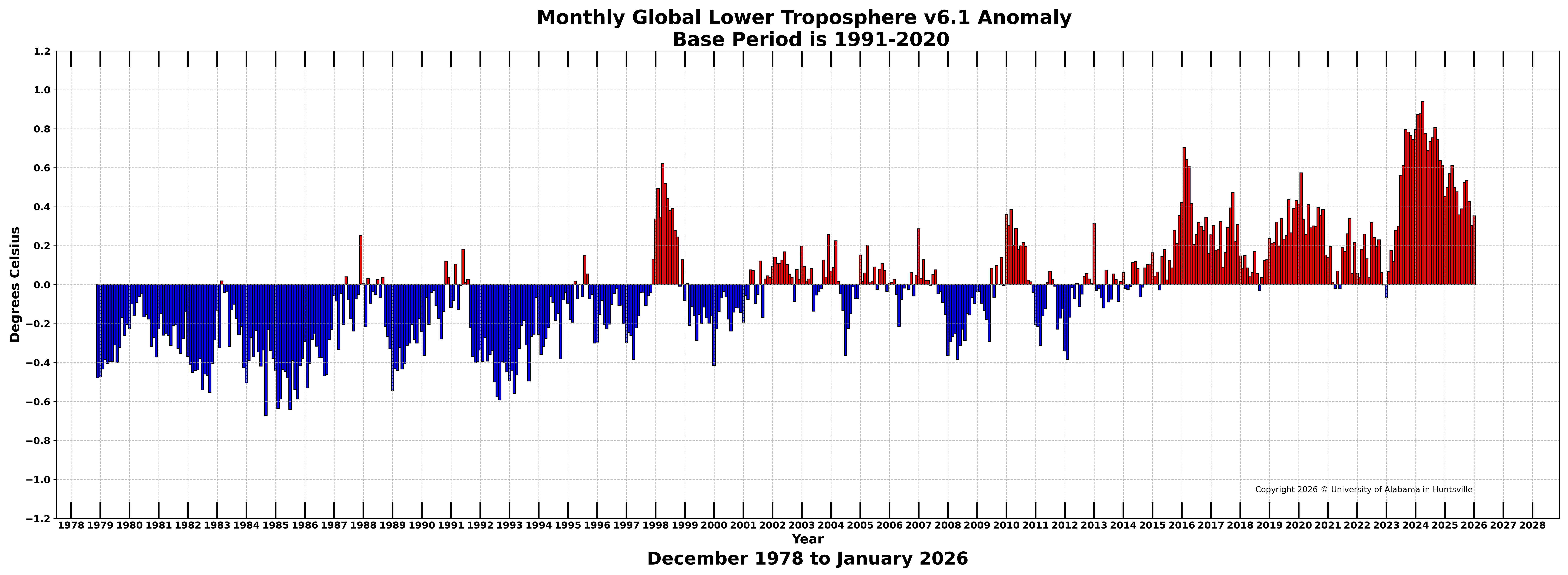
Not, one fears, by accident. But, and it is our key issue, had the Post journalists been paying attention instead of goofing around while waiting for their layoff notice to arrive, one thing they’d have noticed is that their “past three years” which did indeed happen, as years will, show a spike up through 2023 and 2024 and then a drop to 2025. So their trend isn’t 30 years, or 10, or even three. It’s two. Two measly years.
If the writers had looked at the University of Alabama Huntsville lower troposphere data, about the best there is, they’d realize that by now we are, nevertheless, more or less back to 2016 numbers. The fabled hiatus alarmists rudely deny existed, from 2001 through around 2015, seems to have been replaced by a new plateau. And that very recent spike, whatever it was, certainly cannot have been caused by CO2 because it was too sudden, short and, it seems ephemeral. Hunga Tonga, maybe. Or even the mysterious decrease in cloud cover in recent decades. But not CO2. There’s just no mechanism that could let it drive a sudden spike. None at all.
The Post itself actually explains why, by accident:
“Since the 1970s, the Earth – fueled by enormous quantities of greenhouse gas emissions – has been warming at a fairly steady rate.”
And leaving aside that obligatory “fueled by”, it’s worth noting that human GHG emissions were in fact increasing during that period, and not trivially. So if temperature was increasing at a steady rate, the logical conclusion is either that CO2 isn’t driving it or that the warming potential of CO2 was being exhausted. (As in fact the whole notion of ECS as a constant implies; the more CO2 is in the atmosphere, the less impact any fixed addition has.) But if so, then the temperature curve should have been level or even tapering off.
It was level until something odd happened. So even if you hold the Enhanced CO2 Effect hypothesis, you should be looking for an external shock here. But climate science isn’t like the normal kind. Instead you jump to conclusions, and to reliable alarmist sources:
“‘We’re not continuing on the same path we had before,’ said Robert Rohde, chief scientist at Berkeley Earth. ‘Something has changed.’”
Now according to the Post:
“For about 40 years – from 1970 to 2010 – global warming proceeded at a fairly steady rate. As humans continued to pump massive amounts of greenhouse gases into the atmosphere, the world warmed at about 0.19 degrees Celsius per decade, or around 0.34 degrees Fahrenheit. Then, that rate began to shift. The warming rate ticked up a notch. Temperatures over the past decade have increased by close to 0.27 degrees C per decade – about a 42 percent increase.”
Well, yes and no. That alleged trend phase shift thing depends on treating 2023-25 as part of the linear regression rather than an outlier. If you don’t, nothing changes. But again, climate science isn’t like the normal kind:
“Those data – combined with the last few years of record heat – have convinced many researchers that the world is seeing a decisive shift in how temperatures are rising. The last 11 years have been the warmest years on record; according to an analysis by Berkeley Earth, if we assume a constant rate of warming since the 1970s, the last three years have a less than 1-in-100 chance of occurring solely due to natural variability.”
Of course the last 11 years are not the warmest “on record”. They’re just the warmest in the modern thermometer record, a critical distinction. And the mathiness of that “less than 1-in-100” dazzles the writers and possibly the audience. But what does it actually mean?
Presumably that less than once in a hundred years do you see a sudden spike. Not never. Not unknown to nature. Just reasonably unusual. But how do they know? What sort of records do we have from the pre-thermometer era that let us judge not only whether the Holocene Climatic Optimum was warmer than the present (definitely yes) but whether, in the 8,000 years since, or the entire Holocene, or for that matter the 2.58-million-year Pleistocene Ice Age, or go back further if you want, it was unusual or even impossible to have temperatures go up by 0.2˚C in three years, or whatever they think happened. (The article typically manages not to say.)
YaleEnvironment360, which passes the hat for “independent journalism” while receiving funds from sources including the billionaire Heinz Foundation, the billionaire William Penn Foundation, and the multimillionaire Band Foundation, and of course the multibillionaire Yale University itself, makes the same mistake slightly differently:
“From 1970 until 2015, the planet heated up at a rate of 0.2 degrees C per decade. But over the last 10 years, temperatures rose by an unprecedented 0.35 degrees C, according to a new study published in Geophysical Research Letters.”
So not for them 30 years. Just ten. But it’s not even ten. It’s just three, not a trend, especially with the third year cooler than the second. But it gets worse. To call 0.35˚C in a decade “unprecedented” means, it must mean, that you know the temperature never rose by a third of a degree in a decade. And how would they? What data do they have that would justify such a statement?
None whatsoever, of course. Even 19th-century thermometers were not sufficiently accurate to record such a thing, a one-third-of-a-degree change, even in one place. Nor were temperatures measured in enough places at all, let alone with rigorous enforced standards about measurement conditions, to tell us whether there was such a spike between, oh, say, 1873 and 1876. They’re just making it up. And once you get to the proxies, hoo hah. To say nothing of the error bars. Which indeed they say nothing of.
But wait. We actually do have some proxy data that illuminates the situation within limits. Antarctic ice cores appear to show that the entire 1.1˚C warming in the last century, since the 1920s, is “not even unusual” by comparison with the last 20,000 years. Instead, a new study of those cores claims:
“16% of the centuries since the end of the last Ice Age show a rise at least as big [1.1°C] as the current century.”
Now if you were in the clickbait business, successfully or otherwise, you might try to headline it “Recent warming had only one-in-six chance of being natural”. As would also be true of all the other natural warmings that large within a century. Which didn’t stop them from happening or being natural, now did it?
Finally, to return to the Younger Dryas, this odd period shortly after the end of the last glaciation when temperatures plunged dramatically then shot back up, our best guess is that the Northern Hemisphere warmed by 4-5˚C in a few decades. So babble about how an unmeasurably small 0.35˚C is unprecedented is just babble. Although we were pulling your leg there. It wasn’t the Younger Dryas. It was the “Bolling warming” around 14,500 years ago. The Younger Dryas started roughly 12,900 years ago and ended roughly 11,700 years ago. But yes, it saw equally dramatic warming (and before that cooling), equally dramatic here meaning both faster and larger than what we’ve seen since 1920 or, if you’re counting, since 2022.
In fact Wikipedia says of the Younger Dryas that “Statistical analysis shows that the Younger Dryas is merely the last of 25 or 26 Dansgaard–Oeschger events (D–O events) over the past 120,000 years” all of which, again, saw dramatic changes over very short time periods. Almost as if it were, what’s that word, natural.





Once again,there is no such thing as "settled science".You listening,BO?Science is not consensus,and consensus is not science.
"there’s a lot of natural variability, which said there was no statistically significant acceleration in warming" this statement is false, not supported by any data, and the author is incompetent on the subject of climate science ... i could write a complete article refuting the many false claims in this article, but why should i waste my time when i've already wasted my time reading this article? ... for one simple example the D-O events were only during glacial periods not during an interglacial that we are in now .... for another example there is near zero evidence that any time in the past 10,000 years was warmer than the past decade ... my final example: every measurement of the global average temperature shows the firtst 25 years of global warming from 1975 to 2000, had warming at a slower rate than the next 25 years from 2000 to 2025: much of the information used in this article seems to be from a scientist named matthew weilicki who i consider a fraud and i do not read his articles:
https://medium.com/@pbercker/debunking-wielicky-again-the-would-be-climate-skeptic-b00101805857
Richard, it seems that you have an axe to grind with Wielicki. Every time he is referenced in a CDN article you have a little rant. As for this article, there is a lot more to criticize than what Wielicki wrote but you only seem to have been triggered by him. The article only quoted him on one aspect which is not particulary controversial. You medium.com link is more of the same and doesn't touch the topic of the CDN article. It's just more ranting on Wielicki. So I'm intrigued and I do think you should write your "complete article". But please, if you do, work on the grammar.
[…] warming faster than the rest of the worldBy John Robson, Climate Discussion Nexus, Mar 18, 2026https://climatediscussionnexus.com/2026/03/18/earth-warming-faster-than-the-rest-of-the-world/In fact, Wikipedia says of the Younger Dryas that “Statistical analysis shows that the Younger […]