
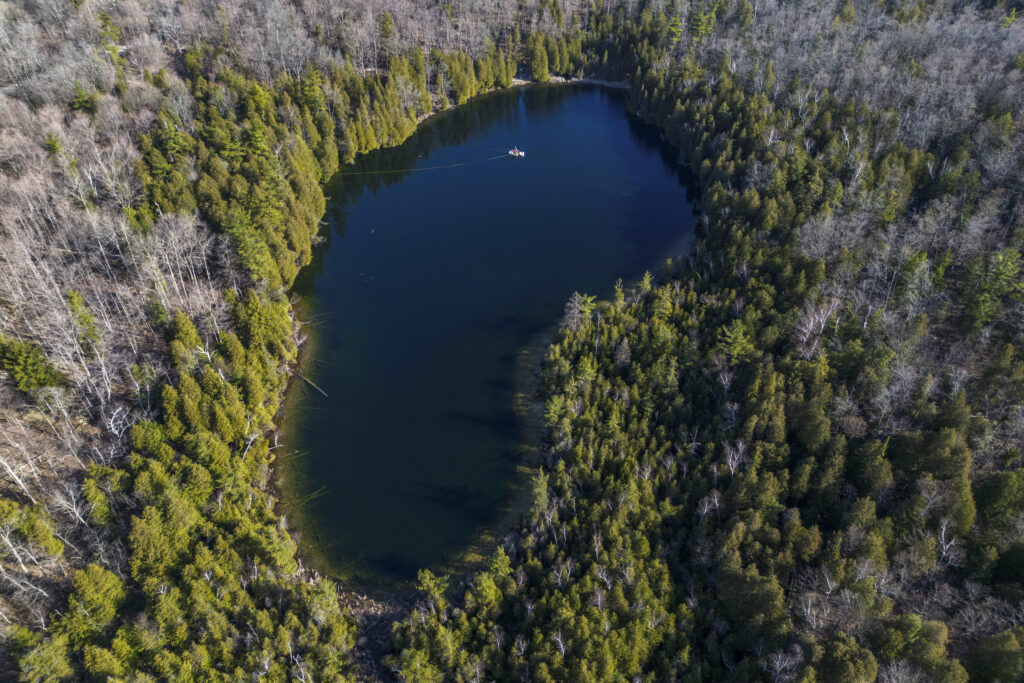
But what they had to say was buried at the bottom of Fish Lake, a shallow body of water in a remote forest of New Brunswick evidently named by people who were running out of ideas. (“See, it’s one of those lakes with… fish in it.”) In 2023 researchers took a core from the bottom of the lake and in a new paper they discuss their examination of its layers of pollen and charcoal, which enabled them to create a climate record going back to 850 AD. You will be astonished to learn that the Medieval Warm Period and Little Ice Age show up clearly, that over time the mix of forest species has changed and that forest fires were very common long before there were people to cause them, including by causing global warming. Or not. Perhaps we should rename it Duh Lake.
Past authors have argued that the region is too wet for forest fires to affect the forest ecology. But the charcoal deposits revealed 19 major forest fires over the sample from 1068 to 2023. The four years with the maximum charcoal accumulation were 1068, 1298, 1818, and 1893. And despite the climate fanatics’ dogma that warming means more burning, the actual charcoal record showed that forest fires were more common in the Little Ice Age (LIA), roughly once every 43 years, than in the Medieval Warm Period (MWP), roughly once every 67 years.
Meanwhile the pollen record showed that the mix of dominant trees varied over time. In the early MWP birch and hemlock were dominant, with maples also present. As the LIA set in conifers became more dominant while maples held their ground. During the depths of the LIA the European settlers began arriving and so did more and more conifers. But as the colonial period went on the pollen record showed evidence of cultivated plants including herbal shrubs. At present Red Spruce is dominant. Climate changes constantly, it seems.
The authors also used the pollen record to reconstruct temperatures and precipitation. Here are the Spring (March-April-May, top panel) temperatures and the winter (December-January-February, bottom panel) precipitation records:
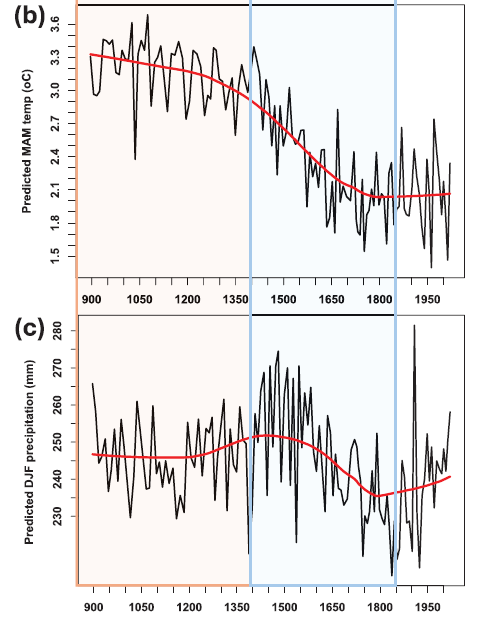
The top panel shows, what’s this? A very warm MWP followed by steady cooling up to around the present. And the precipitation record shows an upward trend since 1850, but following a long decline through the LIA and still below MWP levels.
So the MWP and LIA show up in ancient proxy records yet again, in this case from pollen and charcoal layers at the bottom of a remote lake in New Brunswick. Those scientists who are determined to get rid of the MWP are going to need a lot more pavement.


one local proxy cannot be extrapolated to guess a global average temperature
even of average of every local proxy in the world at the same time period does not give us an accurate global average temperature. jumping to any conclusions about the global climate from one local proxy is science fraud