
Does anyone remember the Stern Review? Ah, sic transit gloria mundi, because it was a big deal in 2006. Sir Nicholas Stern was a UK treasury official tapped by then Chancellor Gordon Brown to write a report on the economics of climate change. He was quickly recruited into the alarmist wing of the UK climate establishment including the University of East Anglia Climatic Research Unit, then basking in its pre-Climategate prestige. And he delivered, because his report somehow concluded that without immediate action climate change would “be equivalent to losing at least 5% of global GDP each year, now and forever.” Wait, was that not scary enough? OK then: “If a wider range of risks and impacts is taken into account, the estimates of damage could rise to 20% of GDP or more.” But not to worry, he also claimed that the world could decarbonize at little or no cost. As we have noted, there’s no logical connection between the severity of a crisis and the ease of solving it, but somehow climate alarmists have been hammering away for decades at the notion that we’re in an existential catastrophe we can fix without breaking a sweat. Instead we’ve broken our economies without the bad weather showing up. In Stern’s case, the UK government under Labour and Tories alike, in a classic display of why bipartisanship is bad, eagerly followed his advice into its current climate policy-induced economic tailspin. And to think the public is losing faith in the crisis and their would-be saviours. But Roger Pielke Jr. has a suggestion as to what went wrong: it was an illusion from the start.
The Stern Review came in for plenty of criticism at the time for its alarmism and shaky economic analysis. One of its deficiencies was predicting a rapid increase in extreme weather events and a growing fraction of the world economy that would be lost to floods, hurricanes, drought etc. In a new analysis at his Substack, Pielke Jr. shows that Stern was wrong the day it published and has gotten more wrong ever since:
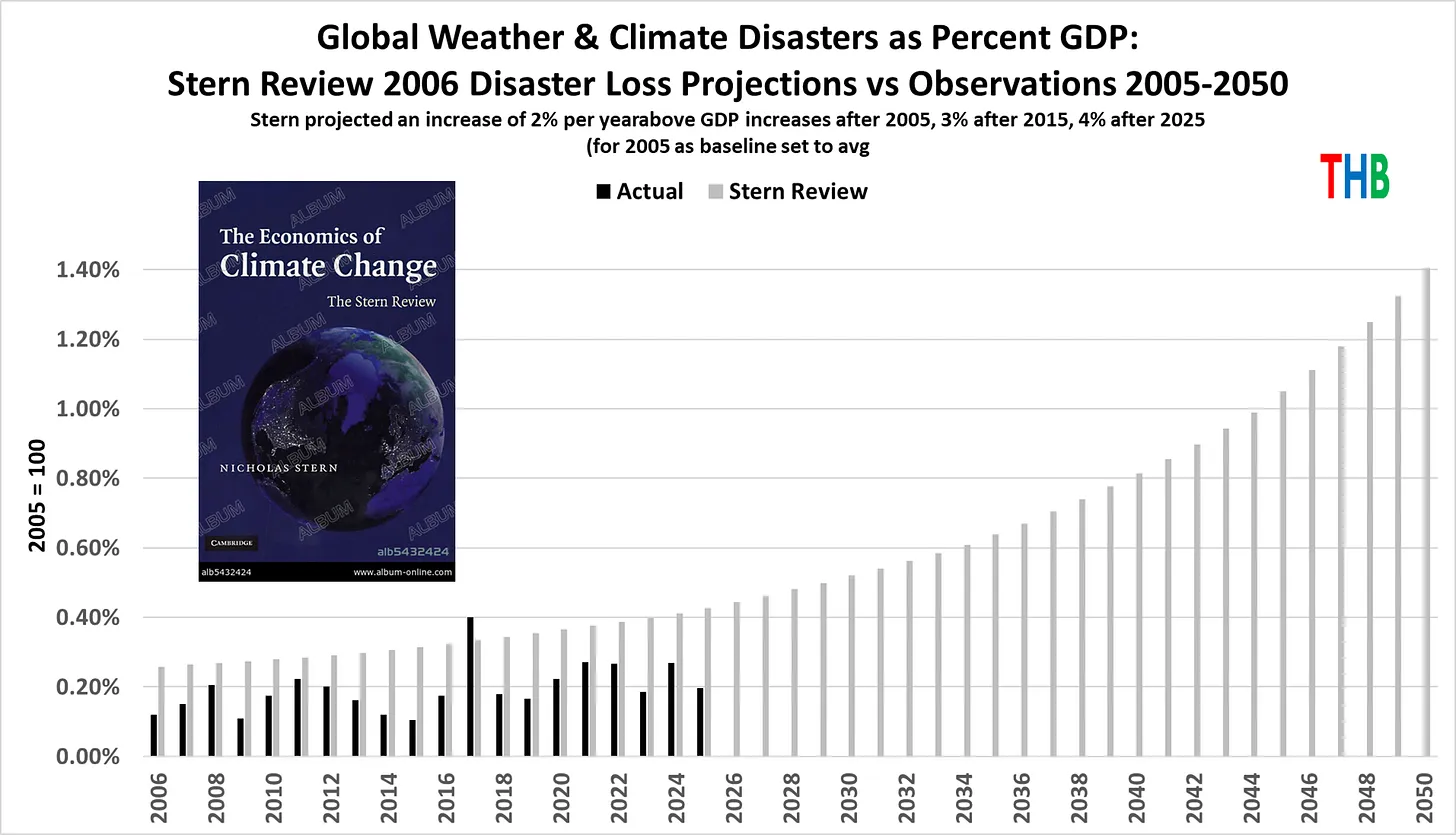
The gray bars show Stern’s estimate of the fraction of the world’s economy that would be lost to weather and climate disasters annually. The black bars show the actual record. In only one year (2017) did actual disasters exceed the Stern estimates. In the rest, including in 2006 itself, real world damages have been far below Stern’s predictions. Pielke Jr. notes:
“The Stern Review forecast rapidly escalating losses to 2050, when losses were projected to be about $1.7 trillion in 2025 dollars. The Review’s prediction for 2025 was more than $500 billion in losses (average annual). In actuality losses totaled about $200 billion in 2025. The forecast miss is not subtle.”
He sums up the problems with the Stern Review as “bad science”. And missing science. After checking the sources cited by Stern and realizing they didn’t support his projections he says:
“Where do these escalating numbers come from? Who knows. They appear to be just made up out of thin air.”
Now here’s how science is really done. Pielke Jr. published his critiques of Stern’s projections at the time and correctly predicted they would fail. He was right, but his criticisms (like most others at the time) were ignored. What about now?
On which point we have to remind readers that climate alarmists have a nasty habit of accusing climate skeptics of being in it for gain. But it’s people like Stern who actually benefited, financially and socially, from the positions they took.
Stern himself became a fixture in the global policy elite and went on to impose his mangled analysis on the UK. Now, 20 years later, it is probably too much to hope that the global policy elite will disown him and his flawed report. But at least those countries that have learned they need to disown the global policy elite stand a chance of retaining their prosperity.




When the zealots finally acknowledge the absence of increasingly common devastating weather events, they will take credit for having imposed net zero (despite the failure to curb CO2 levels).
Well, climate change, or rather, hysteria about climate change in the shape of British politicians, notably Ed Miliband, has created just such a downturn in GDP, with the UK deindustralisation proceeding apace because our energy is priced at four times what Americans pay in a lone bid to save the world from our 0.7% of total anthropomorphic CO2.