
This part of the DoE Report concerns the layer of the atmosphere between 1 and 16 km altitude, namely the troposphere. Climate models say the warming there, at least over the tropics, will be strongly amplified by a water-vapour feedback mechanism. We did a video on the topic a few years ago which covers one of those problems climate modelers and other insiders are privately very aware of but prefer the public doesn’t hear about: the models predict a lot of warming that isn’t happening. And not just a few of them. All of them. Every single major computer simulation of climate predicts too much warming and the modelers know it. So it isn’t a case of uncertainty. It’s model bias helpful in polemics but anti-science. And the DoE group show the receipts.
The report authors present an updated version of results in a paper by John Christy and Ross McKitrick from 2020 which showed trends in model reproductions of troposphere temperatures versus observed data since 1979 (the year satellite data became available).
The models are in red and the observations are in blue, with each dot representing the trend in degrees C per decade since 1979. There are three blue dots because there are three observational systems: satellites, balloons and reanalysis (data from weather forecasting models), while the horde of red dots shows the predictions of 39 climate models. And there are four boxes because the top row shows mid-troposphere and the bottom row lower troposphere, while the left column shows the entire planet and the right column just the tropics (where the models say warming should be strongest):
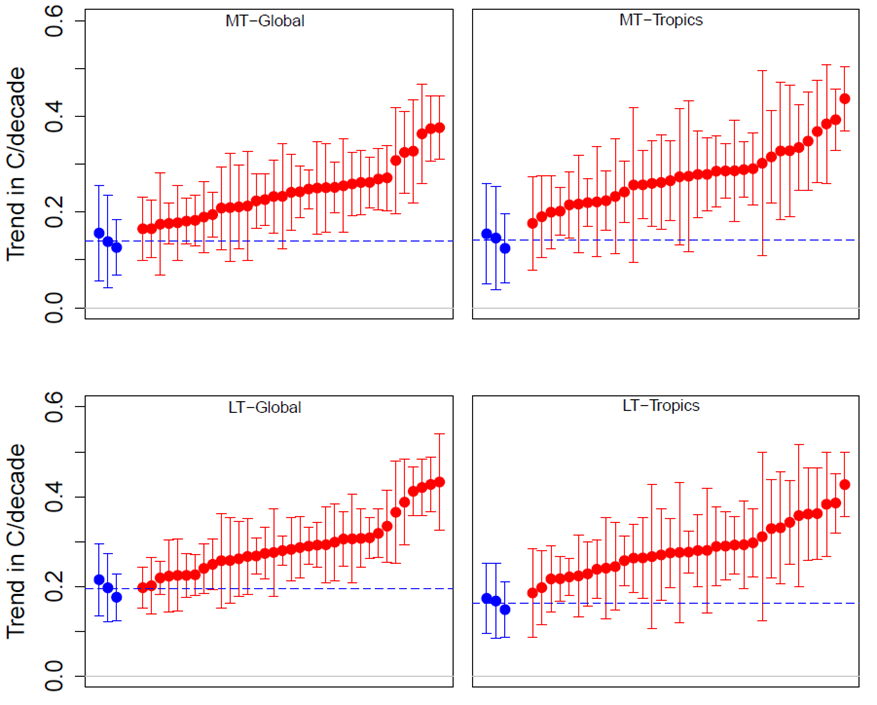
It’s pretty clear that the model warming trends are too high, and in many cases way too high. So what do the models with too much warming have in common?
Simple. Very high Equilibrium Climate Sensitivity or ECS (the absolute increase in temperature supposedly caused by a relative doubling of atmospheric CO2). Therefore, of course, the models that get the warming more accurately have low ECS. And of course those models also project very little warming over the coming century.
The DoE report notes that the IPCC recognizes the problem that the models systematically overpredict warming. But (drum roll please) it buries it in the back of its assessments where the only people likely to find it are the sort who won’t go blabbing about it. And despite the problem having been known for decades and despite it getting worse and worse with every generation of models, exactly as though their creators considered it a feature not a bug, the IPCC only assesses that the models are biased with “medium confidence”. You have to wonder what more they would need to assign it high confidence.
Maybe another year of data? Alas no. A new post by Dr. Roy Spencer at his blog confirms that, even with 2025 data added in, the model bias is as large as ever, which Spencer called the ongoing “Epic Climate Model Failure”. Then again it’s not so much a failure of models, which after all are just tools for research. It’s an epic failure of science to correct itself, and of groups like the IPCC to explain to readers what’s been going on.
But wait... there’s more. As we will show next week, the problem isn’t just too much warming, it’s a vertical pattern mismatch that goes right up into the stratosphere. Maybe that’s why that movie was called Don’t Look Up.





Ah yes, the elusive mid latitude "hot spot" feedback! I remember a style manual from one of the Federal Agencies a couple of decades back advising report writers to "avoid the use of 'positive feedback', the standard engineering term, and rather say "enhancement of negative effects" or similar language when referring to this undocumented process.
Climate models from the 1970s and early 1980s predicted global warming at a rate of approximately 0.20°C per decade when accounting for actual greenhouse gas emissions. The surface warming was 0.2° C per decade. ... Conservatives have been lying about this since 2013. I believe John Christy started this deception. A 2019 study led by Zeke Hausfather found that 14 out of 17 historic model projections (dating back to 1970) were statistically indistinguishable from actual observations when accounting for the real-world rise in CO2. 12 years of lying about this and here we go again.
Recent satellite and weather balloon data confirming this hotspot & provide physical evidence that matches climate model predictions for greenhouse-induced warming.
Balloon radios on data are not acceptable to calculate a global average temperature. There are roughly 900 to 1,300 launch sites globally, but they are primarily located on land. Vast areas of the oceans and polar regions have fewer or no balloon launches.
Climate models from the 1970s predicted that the most significant global warming would occur in the polar regions rather than the tropics. The article falsely claimed just the opposite.