
The Manhattan Contrarian reports that the data are in on Hurricane Isaias, the cyclone that recently made landfall along the Florida coast, briefly raising the hopes of alarmists everywhere that they wouldn’t look like, well, alarmists after warning us for so long about climate change making hurricanes worse and worse only to have an entire season go by without one making landfall along the US Atlantic coast. Apparently if they can’t find a brutal storm they’ll make one instead. But drawing on data collected by Paul Homewood, the MC shows that claims that Isaias made landfall as a Category 2 or higher are not supported by the available data, instead it limped ashore as a Category 1. Amidst our relief that the storm was a manageable one the MC now insists that the data allow us to reject, finally and firmly, the claim that climate change would hurricanes to get worse. “I think that we are well past the point where the ‘more and more severe storms and hurricanes’ hypothesis has been falsified” he declares. And in case anyone accuses him of cherry-picking the North Atlantic, he welcomes us to look at the worldwide record.
Not that we are obliged to. If North Atlantic hurricanes specifically were getting more numerous and more severe the climate crowd would claim it as vindication for their prediction. Indeed they have done, and in a very peculiar fashion. Any time there is a severe North Atlantic hurricane they point to it as vindication, even if it’s in a year with completely normal storm numbers. It being North Atlantic hurricanes in particular not hurricanes worldwide. So they do claim to have made a prediction, though typically only after the phenomenon has taken place. But North Atlantic hurricane numbers are not going up, nor is intensity, and this year has been record-setting for its quietude.
OK, then. Maybe all the storms are in the Pacific. And yes, there have been typhoons there this year. According to the Colorado State University real time tropical cyclone tracker there have been 24 hurricanes there this year compared to the historical average of 20.6 for this time of year, including 17 major hurricanes compared to the historical average of 11.3, “Gotcha!” right? We’re all going to die? Woo hoo!
Except not really. Looking at the Roger Pielke Jr. Extreme Weather dashboard entry on tropical cyclones the global Accumulated Cyclone Energy (ACE) index, which adds up not just the number of cyclones around the world but the energy they pack, is up a tiny amount this year but shows a declining trend overall:
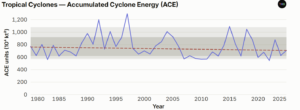
So whichever way we look at it, the hypothesis is falsified. Which matters in real science, though as so often the climate kind appears to be different.
