
A title we never thought we’d see in a Science journal reads “Lessened projections of Arctic warming and wetting after correcting for model errors in global warming and sea ice cover.” Model errors? Lessened projections? Yes, and the surprises don’t end there. The paper by an international team of scientists argues that models get the Arctic wrong because, well, they get the rest of the climate wrong. “Recent studies indicate that some CMIP6 models exhibit excessive equilibrium climate sensitivity (ECS), leading to an overestimation of historical and future global warming.” So they use historical observations to constrain projections and voila, the warming projections fall.
The authors still project warming, and they still project that the Arctic will warm faster than the planet as a whole. But the key point is that when they force the models to look more like reality, the projected warming (and wetting) trends decline across a variety of scenarios, as the following chart indicates with the unadjusted projections in light green, blue and red and the revised lower ones in dark green, blue and red just to the right of their various counterparts:
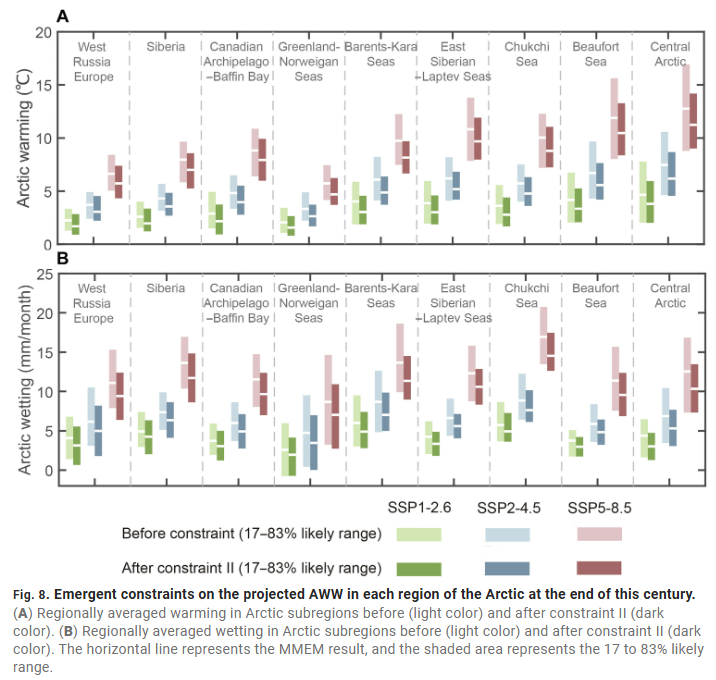
In that chart, within each region there are three pairs of bars associated with low, medium and (very) high emissions respectively. But in every case applying the constraint based on, of all things, historical data always lowers the projected warming trends and wetting trends.
Looking at the warming under the low and medium scenarios after applying the model correction, these scientists are predicting that the Arctic region will warm a few degrees by the end of the century compared to the end of the 1990s. Well, we’ll see. In the meantime get ready for the CDN release of Still Frozen: The Robson Arctic Expedition for an idea of how much a couple of degrees warming would mean in the supposedly delicate Arctic ecosystem based on, again, the dreaded historical evidence.
