- As September draws in and frost approaches the pumpkins Scientific American cautioned on Sept. 9 “You may be less able to cope with stress in winter than in summer” linking to an article about how “During winter, your energy tends to dip, your immune system takes a hit and you may feel less social…. spring’s longer days can make you feel like you’re coming alive with energy, with summer reported as the most active and social of the seasons.” Funny then that they should be so into making the planet colder and even darker.
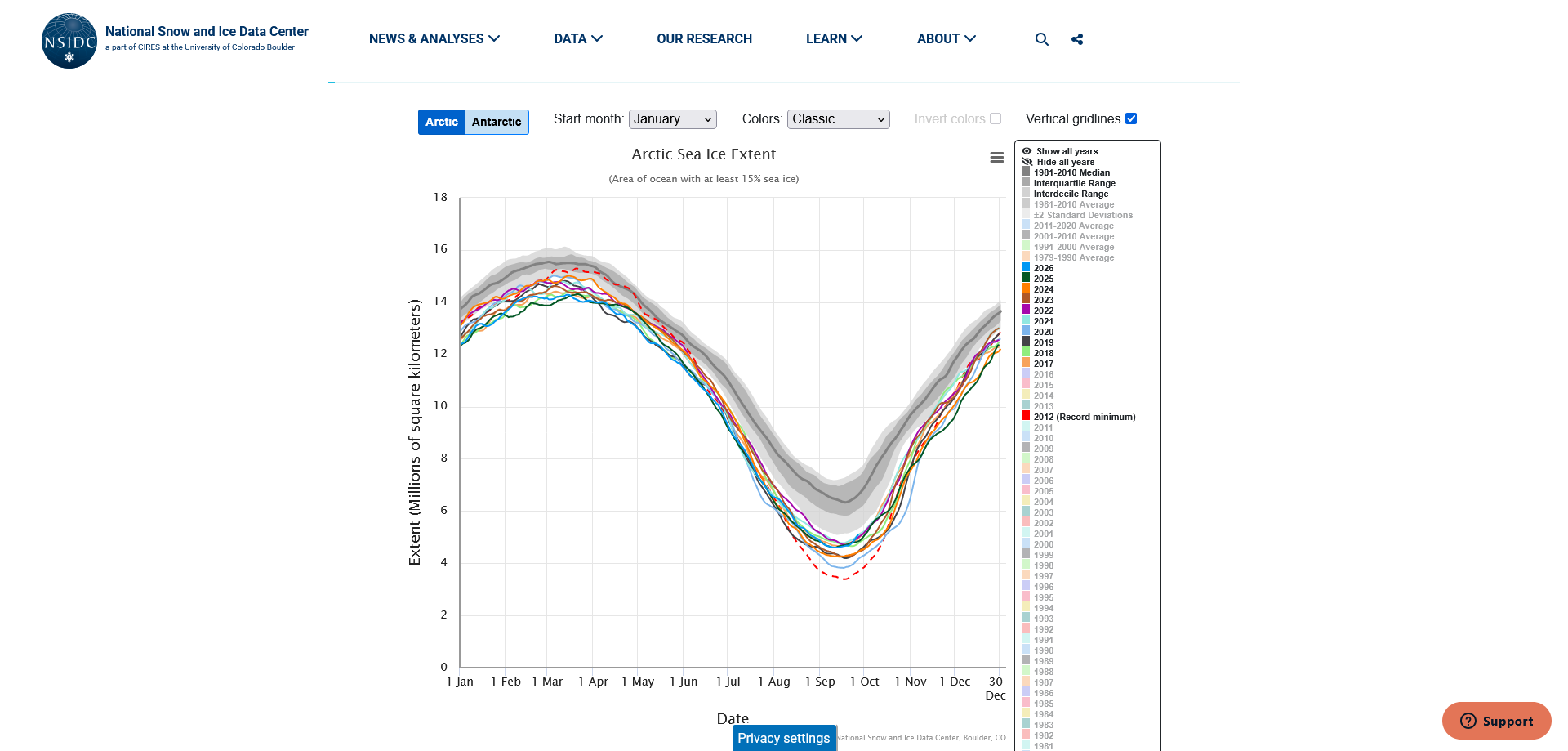
- As we can attest following our trek earlier this year to the far North that pesky Arctic ice just won’t melt. Instead as of Sept. 27, according to NSIDC, it had hit its highest point for that date in a decade, edging out 2021. (And if you recall the kerfuffle when we pointed out a few years back that it had hit its highest point for any Jan. 9 in 20 years, at this point it’s ahead of all but three years in the last 20, those three being 2009, 2013 and 2014. So not exactly relentless melting, is it?)
- From the ever-expanding file on battery fires, Canary Media tells us “Vistra’s Moss Landing grid battery is on fire yet again”. But then they brush it aside (figuratively, the real fire being very hard to extinguish) with “The California facility, with its outdated building and battery design, had a catastrophic fire in 2025. Now, a new fire ignited during the decommissioning process.” But see it’s obsolete. That technology dates all the way back to 2020. Though we can’t help thinking “Vistra has been working on demolishing the site, which entails laboriously removing the intact batteries still in the building, de-energizing them, and shipping them for recycling or disposal” doesn’t actually make it seem as if green batteries are all that green even once they turn red then brown. Or even if they don’t. But next time for sure.
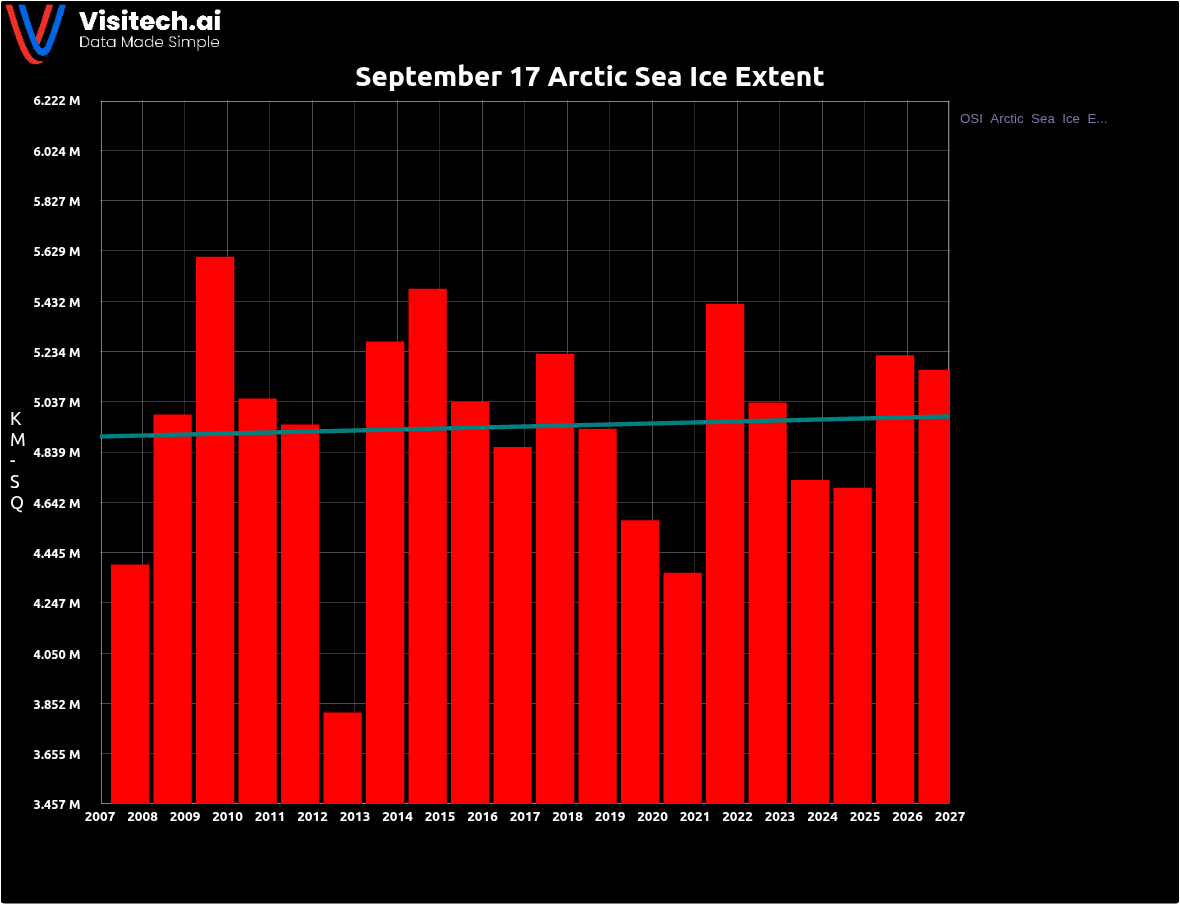
- Here we go again. Everyone including the Canadian government is yapping on about melting Arctic sea ice, the latter saying “there is a greater than two-thirds chance that the central Arctic Ocean will be ice-free most Septembers.” But Tony Heller, the wretch, posts a chart of Sept. 17 Arctic Sea Ice Extent since 2007 that shows a slight upward slope. Drat that ice. Of course we’re not saying 19 years is a trend. But they are, so they might as well at least get the direction right.
- It’s only a crime when the other guys do it. The Free Beacon reports that a shadowy Michael Bloomberg-seeded “Impact Center” at NYU that paid people to work in state attorney-generals’ offices pushing climate cases against fossil fuel companies has gone quiet, archiving their website, deleting pages, changing emails and removing references on LinkedIn. Apparently as state and federal investigators closed in the gang high-tailed it out of town. Imagine if climate skeptics were putting up money to place activist staff in government offices who then scrambled to cover their tracks once their activities came to light. It would be an outrage.
- From the upside-down world of climate science, MSN peddles a Daily Galaxy item “This Lake in Canada Has Vanished After Thousands of Years, And Scientists Say It’s Not Coming Back” as proof positive of climate change. Specifically “the collapse of the Milne Ice Shelf has shown that even these remote frozen environments are not untouched by recent changes.” Whereas it actually proves the exact opposite. This lake, so remote it appears not to have had a name, was “Canada’s last epishelf lake… a rare ecosystem that existed between freshwater and ocean environments.” Not the only. Not the first. The last. And why was it the last? Because the Canadian Arctic has been gradually defrosting for over 10,000 years, since the end of the last glaciation, with ups and downs. “For the lake to return, the ice shelf would need to rebuild itself and recreate the barrier that once separated freshwater from seawater.” Yeah. As in another glaciation.
See Comments 
Tidbits
30 Sep 2026 | Uncategorized
