
The mountains of Tibet provide water for billions of Asians. Sometimes there’s a lot and sometimes there’s not enough. And when there’s a flood, or a drought, you can be certain the World Weather Attribution ghouls will rush forward to blame you and your gas stove, car and preference for eating meat not bugs, based on an analysis of a few recent decades’ worth of data. But thanks to a new study from a team of mainly Chinese scholars (h/t NoTricksZone) we now have some insight into summertime rainfall levels on the Tibetan Plateau all the way back to 1720, based on tree ring reconstructions. And what do you know, droughts and floods are not new hazards after all, and the worst events happened long ago.
The authors used tree ring samples from Tibetan Junipers sampled in a remote area near Nyinghi City, which mostly receives rainfall in the summer months. By correlating the ring widths with local weather records they were able to replicate historical observations and use the statistical model to reconstruct rainfall levels back to 1720. Here is what the results look like:
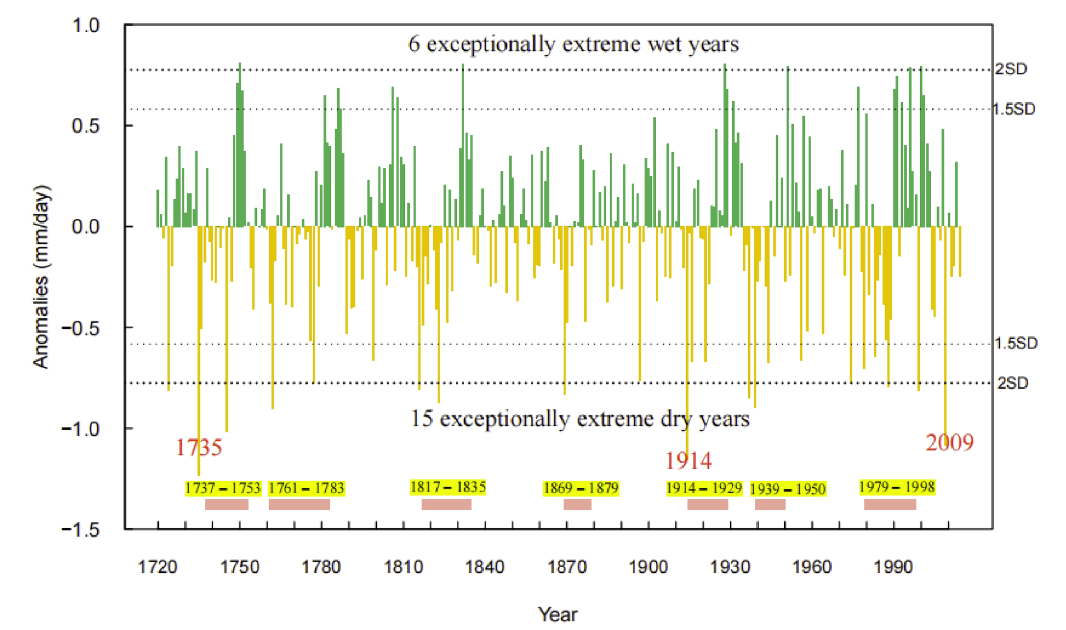
There were seven megadroughts, 15 extremely dry years and 6 extremely wet years over the 300 year span. The authors note:
“Although 2009 was an extremely dry year during recent decades, it was not the severest one over the past 295-year period. The study area experienced more intense droughts in 1735 and 1914... Seven megadroughts occurred in the [Southeast Tibetan Plateau] between 1720 and 2014, specifically during the periods 1737–1753, 1761–1783, 1817–1835, 1869–1879, 1914–1929, 1939–1950, and 1979–1998. Over the same period, exceptionally dry years were more frequent than exceptionally wet years.”
The value of these kinds of studies is not just that they debunk the media hype connecting every dry or wet year to greenhouse gases. They also remind us that the climate system is naturally variable and we have to be ready for extreme events wherever we live. Nature is capable of throwing droughts, floods, heatwaves, hurricanes and every other kind of weather disaster at us all on its own. Rather than wasting money and effort trying to stop the climate from ever changing, our resources would be better invested making ourselves as well off as possible off and more resilient in the face of whatever is coming at us next.
It may well not be pretty. Especially if the past is anything to judge by.

