
With a t of the h/ to Kenneth Richard we learned of a new study on tropical cyclones (TCs) in the Western North Pacific (WNP), a region including coastal China, the Philippines, Korea, Japan, Micronesia and other nearby Asian nations. The study lead authors work at something called the Centre for New Energy Transition Research in Australia and a few of their coauthors work for a reinsurance company so to be honest we were expecting it to be yet more RCP8.5 propaganda to push the energy transition and subsidies for big insurance companies. But no, this study simply looked at the available data on landfalling TC activity from 1980 to 2023 and reported on the trends. Or, as it turned out, lack thereof.
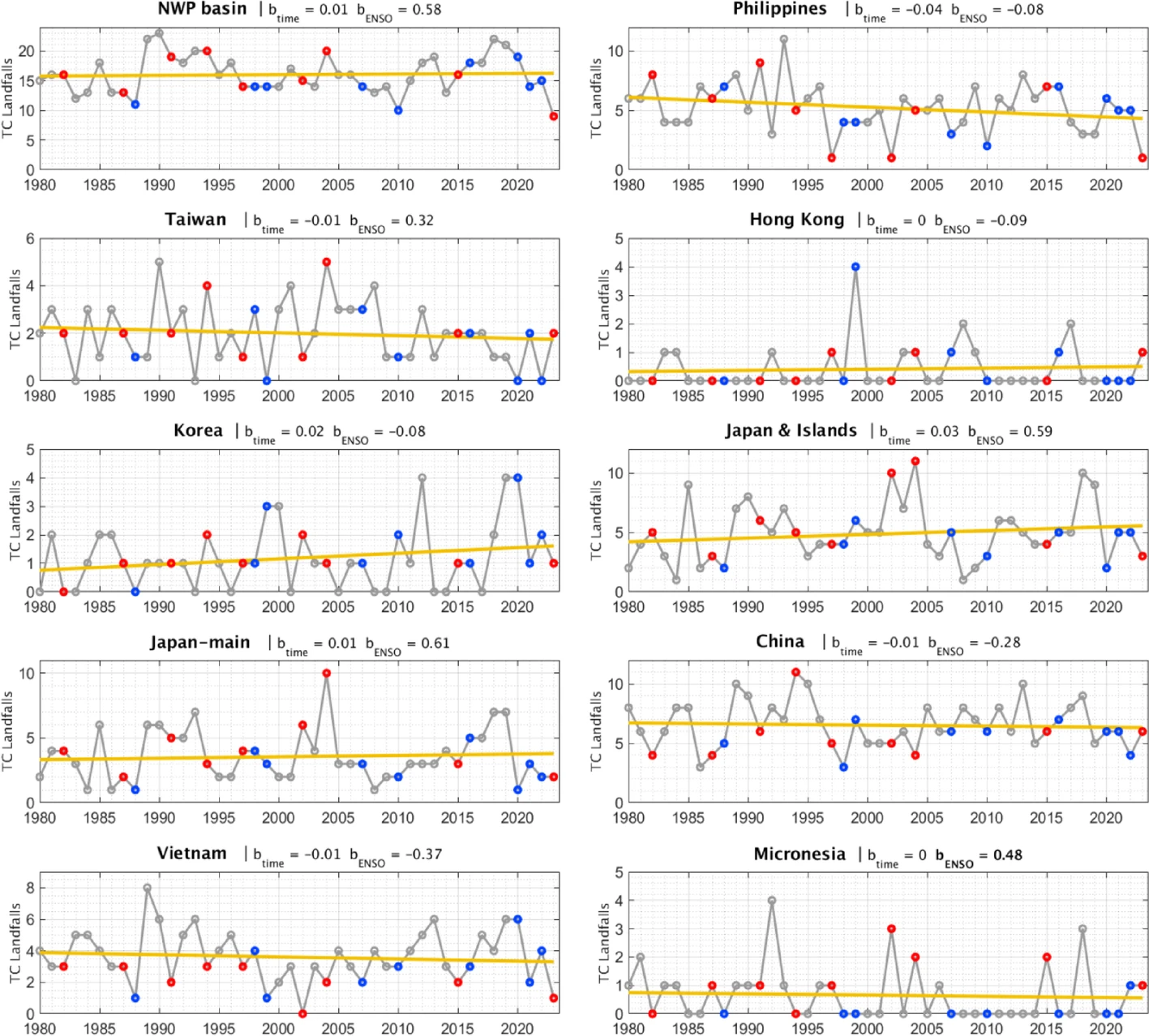
The authors used a statistical method to adjust the TC record for the influence of El Niño and La Niña cycles and then measured trends in landfalls hitting each country in their sample. The pattern is pretty simple: TC counts go up and down, but are not becoming more frequent. For the NWP basin as a whole the trend is zee-row:
The researchers also looked at the Accumulated Cyclone Energy or ACE index, which measures not just how many TCs occur but how much punch they pack. Here again the NWP basin as a whole shows no trend:
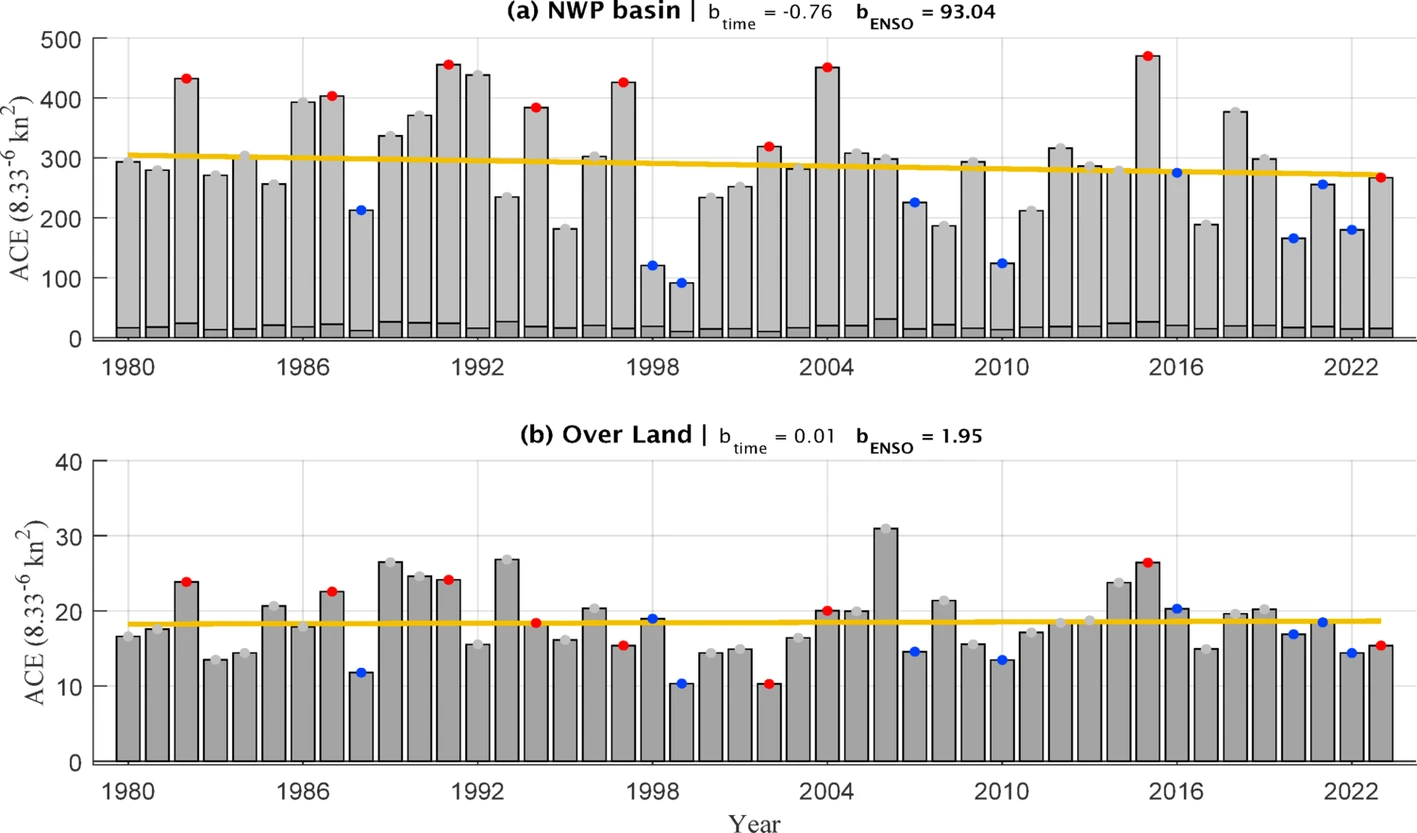
Actually there is a slight downward trend for the NWP as a whole, but over land the trend is once again zee-row.
Dang. Where’s the predicted cyclone apocalypse and all our fault yah boo?
Admittedly in the discussion of this paper on X someone pointed out that climate models do not in fact project an increase in tropical cyclones under global warming. Then why do so many activists and journalists (BWRO) point to each TC when one does occur and holler that it’s an example of the kind of extreme weather that will get worse and worse due to climate change?
It’s not what models project and, more importantly, it’s not what the data show. So anyone who makes such a claim has neither theory nor evidence to back it up. Of course climate science isn’t like the normal kind. But it’s one of the key things that stops us from believing them or trusting them on anything else they say.


I have a fool proof system of determining the frequency of tropical cyclones in the Philippines. I simply call them and ask hat they are experiencing. their comments confirm the reduction as this piece shows !!