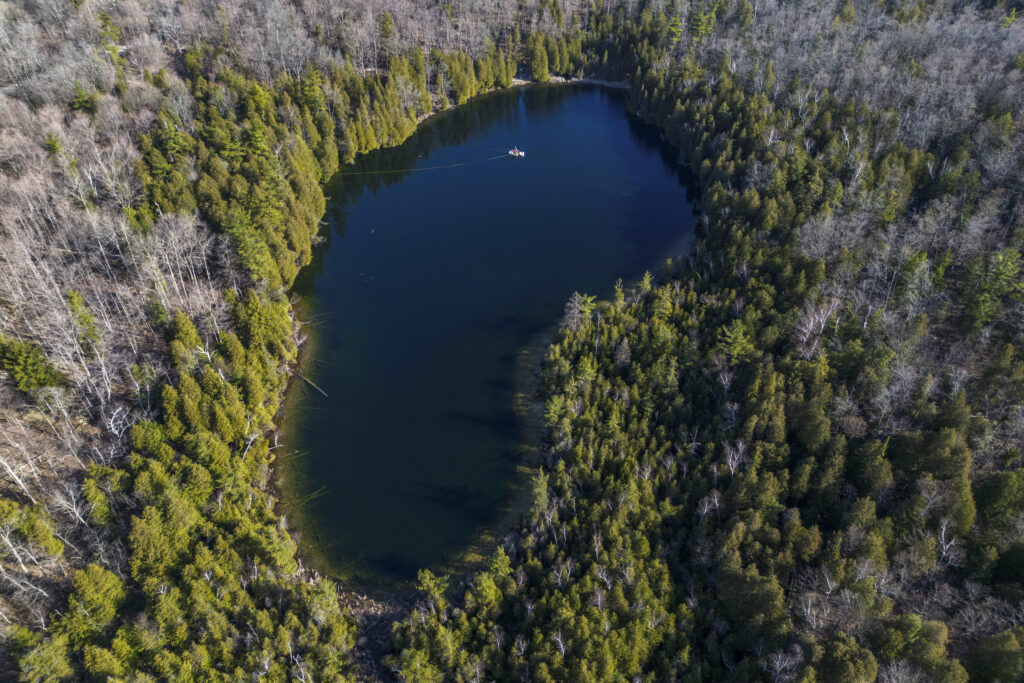
- From the “settled science” file, we learn that “Utah’s Great Salt Lake may be hiding a massive reservoir of fresh water/ Fresh-water-saturated sediment or bedrock may extend as deep as three or four kilometers below the Great Salt Lake’s basin, a new study suggests”. Unless of course it’s not, as we so often say about may/could/might science stories. But we also point out that in stories about climate, we are repeatedly asked to believe that the computer models take everything into account on a global scale, do all the requisite calculations to an impressive number of decimal places, and tell us exactly what will be happening at the turn of the next century. But then when you look at how much real certainty there is even about very specific local things easy to get at, such as, say, the Great Salt Lake, and contemplate what might occur if you started adding or multiplying all those uncertainties together, it’s a bit hard not to laugh right in their screens.
- From the “oh heh heh that hideous green energy trash” file, Bloomberg Green laments that “Thousands of Dumped Wind-Turbine Blades Prompt Crackdown in Texas”. It seems that Sweetwater, Texas is gazing in dismay at the ugly back end of the fabled “Green Energy Transition” as thousands of used wind turbine blades “take up nearly 1 million square feet in a field off Interstate 20” with hundreds more nearby. And it gets worse: “Originally up to 200 feet long – nearly the wingspan of a Boeing 747 – the blades have been cut into thirds, exposing gaping openings. Locals complain they’re a haven for rattlesnakes, collect water that attracts mosquitoes and pose a threat to children living nearby.” Of course it could be said that if you don’t like rattlesnakes rural west Texas might not be for you especially since “Thousands of visitors come to Sweetwater each year for its rattlesnake roundup”. But the punchline is “The town has repeatedly asked the company that left the blades there to remove them, with no success.” And remove them to where? Miesha Adames, Sweetwater’s executive director of economic development, was quoted saying “the blades have damaged the town’s reputation.” No. They’ve damaged wind energy projects’ reputation, because instead of being green, quiet, harmonious and eternal, these ugly monsters with their huge footprint are messy to make, slaughter birds and bats, then wear out faster than we were told leaving unsightly heaps of toxic waste. Makes you long for some good old “carbon pollution”, doesn’t it?
- A major problem with going about repeating dumb stuff is that you come to believe it. Hence a Canadian Press story peddled among others by MSN says “Air quality alerts to become routine without climate action, University of Waterloo study says”. Because if you say “carbon pollution” often enough you start thinking carbon dioxide is soot. According to the story “The study suggests one in three Americans could be breathing summer air considered unhealthy for sensitive groups by 2100 without climate action, a seven-fold increase compared to the turn of this century. (March 31, 2026)” But why? Was the Medieval Warm Period tough on asthmatics?
- Gross us out, eh? According to Canada’s state propagandist CBC, “The business of insect farming was supposed to grow big and fast.” Supposed to? Says who? Who was slavering to eat bugs? Ah, but it doesn’t work that way. Waxing nostalgic over “Aspire Food Group Canada” which was “[b]illed as the world’s largest cricket farm” at 150,000 square feet, it was to churn out “millions of kilograms of protein each year”. Aka bug paste. And beware the passive voice. The CBC goes on “Crickets are touted as a low-carbon protein source, requiring less farmland than traditional livestock and offering the potential to address world food insecurity.” Not hunger, because conventional farming of real food has pretty much dealt with it. But politicians, bureaucrats and activists have societies to reshape like play-doh. Hence this hideous clacking conglomeration of “billions of insects” was beloved of the great and good, not that they were eating bugs, you understand: “The idea had global backing. In 2013, it won the $1-million US Hult Prize, presented by former U.S. president Bill Clinton. It went on to attract investors from the United States, Canada, Ireland and South Korea, along with tens of millions of dollars in federal loans and grants.” And of course, this being Canada, “The facility came online in 2022, entered receivership in 2025 and it remains unclear how much public money was recovered. The story headline was “Ottawa’s big bet on world’s largest cricket farm ran into a simple problem: the ‘yuck factor’“. Thus blaming us for the debacle, not the failure to have a viable business plan. And the real punchline is that “crickets aren’t cheap. A 454-gram bag of cricket powder can retail for $49.99 – more than even premium cuts of beef on a per-pound basis.” So it cost more, grossed us out, probably didn’t even save the environment from the dreaded cows, and went bust despite gobbling down premium subsidies given by government but paid for by us. Classic.
- Ha ha what a dunce that Donald Trump is. After all, with rising oil prices due to the Iran war proving, or so we’re told, that everyone should switch to renewables, here he is denying Cuba oil, sticking his own country with it while they… uh… hang on. The Atlantic “Daily” says “Since January, the Trump administration has effectively blockaded nearly all oil shipments to Cuba, causing conditions on the island to deteriorate dramatically. Electricity is becoming more unreliable, food is spoiling, and a collapsing medical system now risks creating a major health crisis. Some hospitalized Cubans have reportedly already died as a result of the blockade. According to my colleague Vivian Salama, a staff writer who has been reporting on Cuba, it’s all part of the White House’s plan to choke the island…” No, no, guys and gals, it’s “carbon pollution” that chokes societies. Right? Didn’t you keep saying so?
- Speaking of keeping saying so, the Canadian government keeps insisting that Canada is an energy superpower and will shortly become an energy superpower due to their marvellous far-seeing policies that just need a piece of paper to become rhetorical reality. So why, when we’re the fourth-largest producer of crude oil in the world, has the price of gasoline increased by about 40% in the last month, with worse to come? Why don’t we just use our energy superpowers to, oh, say, produce more energy not just more words?
See Comments 
Tidbits
08 Apr 2026 | News Roundup