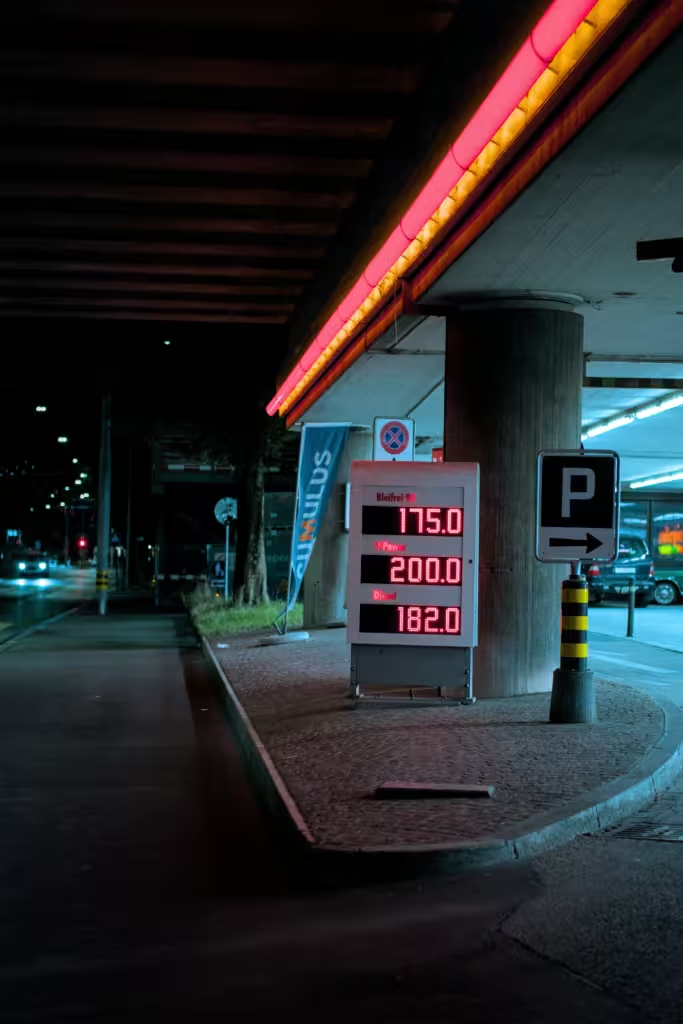
Our trip to the Arctic confirmed for us that hydrocarbon energy is essential to our modern way of life. In places we visited from Cambridge Bay to Yellowknife to Inuvik and Tuktoyaktuk, it was those giant storage tanks of gasoline, diesel and natural gas that made the difference, literally, between life and death. But it’s not just cold places. Even in hot ones, we are far more dependent on functioning energy in vast amounts than most of us seem to have realized. Heatmap warns that “Southeast Asia Is Bracing for an Energy Crisis as Air Conditioner Season Begins”. Which may be true, but whose implications seem to elude them. The Iran war surely underlines two key things by now. First, in a dangerous world you want supply chains that are not just efficient but also robust rather than brittle. Second, in a dangerous world prancing about praising DEI and some fictional Green Energy Transition instead of building on the rock of things that actually work leaves you exposed as a fool.
Heatmap explains:
“Thailand is one of many Southeast Asian countries that rely heavily on the Middle East for fuel, with about 74% of its oil sourced from the Persian Gulf. The vast majority of that must pass through the Strait of Hormuz, which has been effectively closed to tanker traffic since the U.S. and Israel attacked Iran in late February. In some places, the situation is even more dire: 87% of Vietnam’s oil comes from the Persian Gulf. For the Philippines, it’s 96%.”
If you ask what they thought guaranteed the flow of that oil, you may be making an unjustified assumption. Most people evidently didn’t think about it. Neither they nor their governments were able or willing to help the United States and Israel keep the Strait open, or to keep the power on if it closed. They had no Plan B.
Surely at this point we don’t have to tell you, but do anyway, that the area in question is (drum roll please) unusually sensitive to climate change just like everywhere else:
“Southeast Asia is particularly vulnerable: Cambodia, Myanmar, and Thailand are disproportionately affected by climate change, and could experience temperatures of 105 degrees or higher on more than 138 days a year by the end of the century.”
If you ask how it is possible that the Arctic and the equator could be disproportionately affected by climate change they will attempt to hand you a dunce cap. Do not accept it.
Speaking of dunce caps, we have said before and will again that there is no logical connection between the seriousness of a problem and the difficulty of solving it. Things can be trivial and easy to stop, like hangnail, dangerous but easy to stop like Muammar Gadhafi, trivial and hard to stop like athlete’s foot or dangerous and hard to stop like cancer. So there is no reason to suppose that if it is really true that dependence on oil, gas and even coal are having a dreadful impact on the climate it must therefore be easy to stop using them.
We obviously do not think it is true that they are creating a problem. But we certain think it would be very hard to give them up. And we do not see why people who disagree with us on the former point so often seem determined to disagree on the latter despite all the evidence.
As Heatmap also comments of Southeast Asian nations:
“Most have only modest emergency reserves, which will buy them a month, or maybe two.”
Which is definitely to focus on the wrong thing because even if they had bigger reserves, it amounts to the Airplane II solution: “Pretend nothing has happened and hope everything turns out all right in the morning”. What you need is another way to get energy. (In which regard the Canadian Conservatives’ call for a suspension of federal fuel taxes just until the end of 2026 feels like when short-sightedness met clickbait.) And OK, there was a Plan B. But it was silly: rely on wind and solar that manifestly couldn’t do the job.