Chapter 7 in the DOE “red team” climate report released last summer is about rising sea levels. The first part of the chapter reviews data on historic sea level increases and the last part briefly talks about projections of future sea level increases. Which makes it yawn-inducing, at least to us here at CDN, because we’ve been to the sea shore on multiple occasions and seen it for ourselves. It’s very pretty and goes up and down but ends up essentially back where it started. We’ve seen the ups and downs of waves and tides, we’ve seen the waters lapping against historic seaside towns and cities, and we’ve stood on beaches, cliffs and sea walls and taken stock of mankind’s ancient desire to live at the edge of the vasty oceans. To be sure the IPCC, this chapter reports, says that those seas have risen about eight inches since 1900. OK, if you say so. But if you didn’t, who would have noticed? Does anyone think great civilizations can’t move inland, or build walls, at the pace of half a foot a century, as a matter of unremarkable course? As to the forecasts of accelerating sea level increases and inundation of our coasts, we might believe it when the billionaires who fund the climate alarmist movement stop building or buying waterfront mansions.
The DOE discussion of sea level forecasts isn’t very long, and it’s one of the few places in the report where they let their formal tone give way to a bit of snark-level rise. But just a bit. In the chapter introduction they note:
“Extreme projections of global sea level rise are associated with an implausible extreme emissions scenario and inclusion of poorly understood processes associated with hypothetical ice sheet instabilities. In evaluating AR6 projections to 2050 (with reference to the baseline period 1995-2014), almost half of the interval has elapsed by 2025, with sea level rising at a lower rate than predicted.”
Surprise surprise. Then regarding recent predictions by the US National Oceanic and Atmospheric Administration about future US coastal sea level increases the report states:
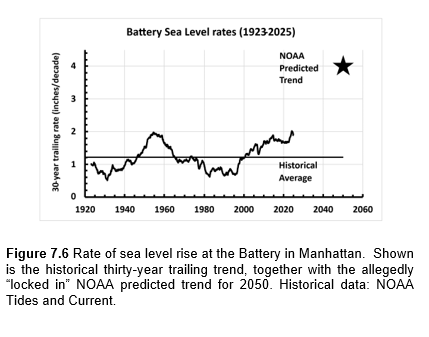
“They claim that by 2050, the sea will have risen one foot at The Battery in Manhattan (relative to 2020). A one-foot rise in thirty years would be more than twice the current rate and about three times the average rate over the past century. In that historical context, NOAA’s projection is remarkable – as shown in Figure 7.6, it would require a dramatic acceleration beyond anything observed since the early 20th century. But even more noteworthy is that Sweet et al. (2022) say this rise is ‘locked in’ – it will happen no matter what future emissions are. We should know in a decade or so whether that prediction has legs.”
And here is the Figure they referred to:
Sometimes to discredit the alarmists all you have to do is report what they say.
P.S. What’s up with that sharp rise from 1930 to 1955? Not a natural fluctuation, surely?
Next week: Uncertainties in attribution.